

Travertine Flexible Stone Supplier Selection Tips for Durable and Stylish Interiors
2026-08-21
Choosing travertine flexible stone isn't a box-ticking exercise—it's the moment your interior either gains a decade of quiet resilience or starts showing compromises within a year. You already know the look: the warm, layered movement of travertine that makes walls feel grounded and light at once. But durability depends less on the stone itself and more on the supplier's process, raw material, and finishing standards. In this guide, we break down the practical checks that separate a reliable partner like Magic Stone from the rest—so you can spec with confidence and style.
How to Tell If It's Genuine Travertine, Not a Lookalike
Real travertine rarely plays it safe. The genuine stone carries the fingerprints of its formation—tiny pits, irregular troughs, and a soft, granular surface that catches light differently from angle to angle. If your sample looks too consistent, with a repeating pattern or an even, plastic-like sheen, that's your first red flag. Most lookalikes are either printed porcelain or resin-based panels that try to mimic travertine's appearance but end up with a flat, screen-printed texture. Flip the piece over; authentic travertine will have a rough, pitted back that mirrors the face, while fakes often show a smooth grid, mesh, or untextured reverse side.
Pick it up and let your hands do the judging. Travertine is a sedimentary limestone, so it has a density and coolness that imitations struggle to copy. A real tile feels heavier than its size suggests and stays cold to the touch for a few seconds even in a warm room. Resin and lightweight ceramic copies feel hollow and warm quickly. Check the edge too: cut travertine reveals a coarse, open grain with occasional tiny shell fragments or mineral flecks. Manufactured mimics have a clean, artificial edge, often with a visible glaze line or a printed pattern that bleeds over the side.
For a closer look, examine how the stone handles its natural voids. Many real travertine tiles are filled with cement or resin to create a smooth surface, but the fill material never disappears completely—it shows as slightly different shades, hairline cracks, or small dips under raking light. A magnifying glass can help you spot the difference between a filled pore and a printed dot. And if you have a spare offcut, place a drop of white vinegar on an inconspicuous spot: genuine travertine will fizz gently as the acid reacts with calcium carbonate, while most lookalikes won't react at all. Just be ready to wipe it off quickly, since the reaction can etch the surface.
The Backing Matters: What Makes Flexible Stone Durable
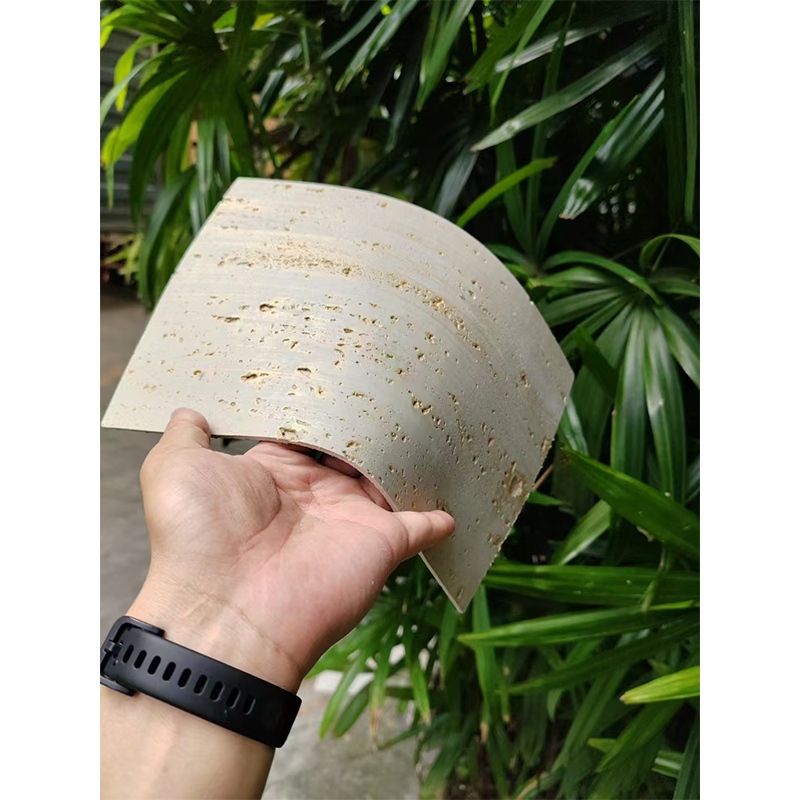
The real secret behind flexible stone’s longevity isn’t the stone face you see but the layer hiding underneath. Most people never think about the backing, yet it’s what stops cracks from spreading, absorbs structural movement, and keeps the whole panel from delaminating over time. Without a well-engineered support layer, even the prettiest veneer turns brittle within a few seasons.
A quality backing does two jobs at once: it gives the thin stone slice enough tensile strength to survive handling and installation, and it acts as a stress reliever when temperature swings or minor substrate shifts occur. Cheaper products often skip this step or use a flimsy mesh that separates after a couple of freeze-thaw cycles. That’s when you see corners lifting and hairline fractures marching across the surface.
Look for backings made from fiberglass or polymer-modified fabrics that stay bonded even when wet. The adhesive matters just as much—polyurethane and epoxy systems hold far better than standard construction glue. If the backing feels papery or peels away with a fingernail, the panel won’t survive real-world conditions. Durability starts from the back, not from the polished front.
Why You Should Demand Samples Before Committing
A product photo rarely matches what arrives at your door. Colors shift, fabric feels thinner than expected, and printed details can look blurry under real lighting. Asking for samples forces the supplier to show you the actual material, stitching, or finish before you pay for a full run. That small preview often reveals flaws you’d otherwise discover too late.
Beyond quality checks, samples give you a chance to compare multiple vendors side by side. Instead of relying on spec sheets and promises, you can hold each option, test its durability, and see which one holds up to your standards. This hands-on comparison makes your final decision far less risky.
A vendor’s willingness to send samples also says a lot about their reliability. Suppliers who delay, charge unreasonable fees, or send low-quality previews often struggle with larger orders. Treat the sample stage as a test run for communication, packaging, and delivery speed, not just the product itself.
Getting the Perfect Shade and Cut: Customization Options
Color swatches on a screen can only tell you so much. The same shade will shift noticeably depending on fabric texture, thread count, and even the direction of the weave. In our experience, the only reliable way to nail the tone is to order physical samples and live with them for a day or two. Tape them beside the window and watch how the color changes from morning sun to evening lamplight. If you're torn between two close hues, consider going one step lighter than your gut feeling—fabric tends to read slightly darker once it's pleated and catching shadows. For rooms with mixed wood tones or strong wall colors, a neutral with a subtle undertone often holds the space together better than a bold match.
The cut is where customization really earns its keep. Off-the-shelf panels rarely account for how a window actually sits in the wall, which is why we measure to the nearest eighth of an inch and factor in stack-back space, mounting depth, and any trim that might interfere with the stack. Arched tops, bay windows, or doors that swing inward all benefit from a cut that follows the architecture rather than fighting it. Edge details matter just as much: a clean straight hem feels modern, while a soft ripple or a tailored band adds a more traditional note. Don't overlook the header style either—pinch pleats, goblet pleats, or a simple rod pocket each change how the folds fall and how much light sneaks through at the top.
Beyond the basics, there's a lot you can do to make the result feel personal. Lining choices alone can transform a room: blackout lining for a nursery, thermal lining for a drafty hallway, or an unlined sheer version if you want the fabric to glow during the day. Add a contrast border, a row of hand-sewn trim, or even a hidden tie-back loop in a leather strap. If you're dealing with a window that's more decorative than functional, consider a mock roman valance cut to just kiss the sill. The point is that these decisions aren't afterthoughts—they're the difference between “nice curtains” and a window treatment that genuinely fits the way you live.
Trace the Stone's Journey: Supply Chain Transparency
On a loading dock outside Verona, a forklift sets a rough block of Calacatta marble beside a scanner. The operator checks the block’s tag against the day’s shipment list, then scans a laminated QR code that has survived rain, dust, and a three-hour delay on the A22. This is where the stone’s journey becomes visible—not through a polished marketing line, but through the same unglamorous record-keeping that has quietly tied quarries to workshops for decades. The difference now is that these records no longer sit in a binder at the quarry office; they move with the stone.
Each handoff adds a new layer to the file. A quarry in Portugal logs the block ID and extraction date before it rides to a sawmill near Porto. The sawmill records which batch it was cut in, how many slabs came out, and what time the truck left for the finishing yard. If a shipment arrives two days late or a pallet shows up with a mismatched label, that gap is part of the trail too. Transparency, in practice, means you see the smudges and corrections—not a clean, prepackaged story.
What arrives with the finished slab is a timeline: where the stone was pulled from, who shaped it, and how it traveled. A designer in Chicago can look up the same block number that a quarry worker in Estremoz wrote on a chalkboard months earlier. It is not magic, and it is not yet universal, but the pieces are small enough to be real—labels, timestamps, signed delivery notes. For anyone who wants to know what “ethically sourced” actually means, that unbroken chain is more convincing than a certificate on a wall.
Installation Support: More Than Just Selling You Panels
When you buy solar panels from most suppliers, you get a pallet of glass and metal dropped on your driveway. We take a different path. Before any order ships, a member of our technical team reviews your roof layout, local wind and snow loads, and even the angle of your mounting rails. If something doesn’t add up, we’ll tell you—and propose a fix—before you spend a dime on hardware.
Installation day shouldn’t feel like a surprise. That’s why every panel set includes a plain-language wiring diagram, a torque spec sheet for the exact clamps you’ll use, and a phone number that reaches a human who has actually installed these panels. No call centers, no scripted troubleshooting. If you hit a snag at 2 p.m. on a Saturday, we’re the ones walking you through it.
After the panels are up, we don’t disappear. For the first year, you get two free remote check-ins where we look at your production data alongside you and flag anything that seems off—a shaded string, a loose connector, a firmware quirk. It’s the kind of support that feels less like a warranty and more like having a neighbor who’s been off-grid for a decade.
FAQ
Request samples from at least three suppliers and examine the surface under daylight. The veining should appear organic rather than repetitive, and the edges should remain intact when you bend the material slightly.
Ask for abrasion and impact test data, and also try scratching a sample with a key. A durable product will show minimal marking and will not peel away from its backing when flexed.
Look for a fiberglass or resin-reinforced backing that is moisture-resistant. Cheaper paper backings can warp or delaminate after steam exposure, so request a small sample and test it in a humid environment for a week.
Yes, natural travertine varies in tone, but a reliable supplier will offer sorted batches. Ask about batch numbers and order all panels from the same production run to avoid visible color shifts across the wall.
A knowledgeable supplier should offer written surface preparation steps, recommended adhesive types, and a direct contact for technical questions. Avoid vendors who only give generic installation diagrams without specific product details.
Extremely low prices often mean a thinner stone layer, weak adhesive, or a low-quality printed pattern. Compare the grams per square meter of the stone layer and request the exact composition before making a decision.
Buying directly from a manufacturer can lower costs and give you better access to custom sizes, but a local distributor may offer faster replacement if sheets arrive damaged. Choose based on lead time and how they handle shipping claims.
Conclusion
Choosing a travertine flexible stone supplier starts with knowing what you're actually getting. A genuine stone reveals irregular veining, natural pores, and slight color movement across each panel—traits that manufactured lookalikes often smooth away. Ask pointed questions about the backing layer, since the composite that holds the thin stone together dictates how well it flexes over curved walls or uneven substrates and how it resists moisture long term. Never skip the sample stage: small swatches in your own lighting are the only way to judge whether the finish, tone, and edge detailing match your interior vision. A supplier that resists sending full-size samples or charges exorbitant fees for them is usually signaling trouble.
Beyond the surface, dig into how the stone travels from quarry to your project. Transparent sourcing—where the travertine was cut, how it was processed, and who handled each step—helps you avoid inconsistent batches and questionable labor practices. Strong vendors also welcome customization, offering precise shade adjustments, custom tile sizes, honed or tumbled finishes, and even mixed cuts for accent walls. Finally, weigh the support you receive after the sale. Detailed installation guides, substrate preparation advice, and a responsive technical team turn a simple panel purchase into a smooth build. The best suppliers act less like order-takers and more like partners who want your travertine to look stunning for decades.
Contact Us
Contact Person: Vito
Email: [email protected]
Tel/WhatsApp: 86 13088879266
Website: https://www.magicstonemcm.com