

Top Spiral Wound Gaskets Factory from China for Custom Industrial Sealing Solutions
2026-11-02
When a standard gasket fails under extreme pressure or aggressive chemicals, the real expense isn't the replacement part—it's the leak, the shutdown, and the safety risk. That's why custom spiral wound gaskets have become the go-to choice for engineers who need a seal matched to exact operating conditions. One factory that frequently comes up in these industrial sealing discussions is Kaxite, a Chinese manufacturer known for producing custom spiral wound gaskets that hold up under tough service. But with dozens of suppliers claiming the same custom label, how do you identify a genuinely top-tier factory? In the following sections, we'll look at the materials, winding quality, testing protocols, and customization options that set reliable manufacturers apart.
Designing Spiral Wound Gaskets Around Your Actual Flange Conditions, Not Just Standard Sizes
Standard spiral wound gasket dimensions assume a clean, flat flange face with uniform bolt loading. Field measurements rarely match that ideal. Flange surfaces may have pitting, warping, or previous gasket residue, and bolt torque often varies across the joint. Designing around actual flange conditions means accounting for the real sealing width available after cleaning, the depth of any surface imperfections, and how those imperfections will affect gasket compression and sealability.
Instead of forcing a stock gasket size onto a worn or non-standard flange, a better approach is to measure the effective seating area and adjust the gasket's inner and outer diameters, winding density, and filler material accordingly. For instance, a flange with slight radial scoring may require a slightly wider winding or a softer filler to bridge the gaps without excessive bolt load. The metal winding tension and number of plies can also be tuned to match the actual available gasket stress, not just the nominal pressure class.
This practice often reduces leakage paths and extends service life because the gasket is no longer asked to compensate for an unrealistic flange geometry. It also helps avoid over-compression on one side and under-compression on the other, which are common with off-the-shelf sizes that ignore real-world deviations.
Filler and Metal Windings That Handle Acids, Steam, and Thermal Cycling Without Early Failure
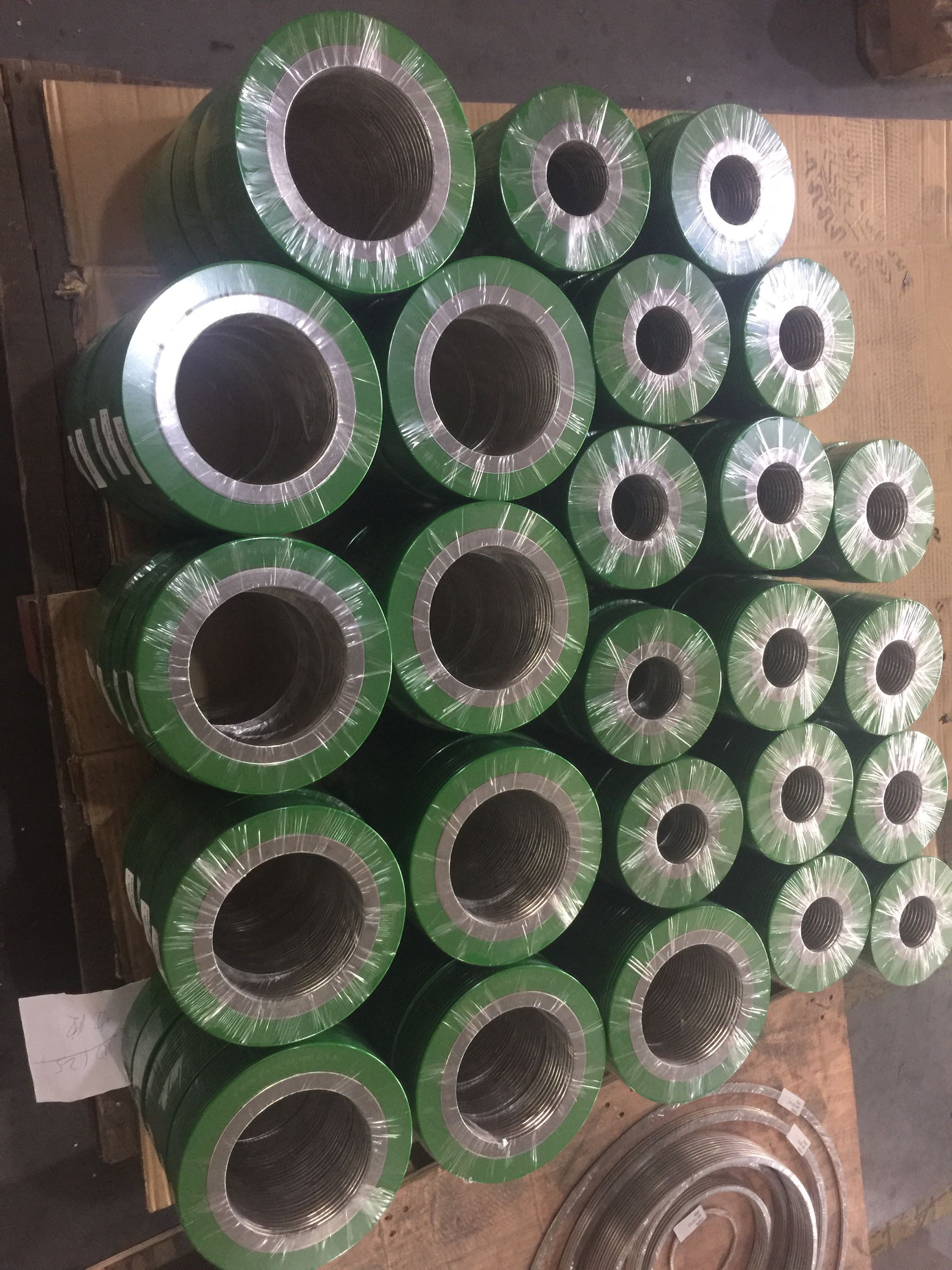
Most sealing failures in acid and steam service come from filler materials that harden, shrink, or chemically degrade after a handful of temperature cycles. Choosing a filler with inherent chemical resistance, such as flexible graphite or PTFE, and pairing it with a metal winding that holds its shape under load changes the failure pattern. The metal core prevents extrusion while still allowing the seal to recover after flange movement.
Thermal cycling is particularly punishing because repeated expansion and contraction tends to loosen seals even when the media itself is not aggressive. A well-designed metal winding distributes bolt stress evenly and keeps the filler compressed without over-torquing. In applications involving sulfuric acid, acetic acid, or saturated steam, that combination resists both chemical attack and mechanical fatigue, so the joint does not leak after the first shutdown or startup.
Maintenance teams using these filler and metal winding systems report longer service intervals and fewer unplanned repairs compared with conventional fiber or rubber seals. The key is matching the filler to the specific acid or steam conditions and selecting a winding alloy that will not corrode or gall over time.
Inside a Chinese Factory Floor: How Every Layer of Your Custom Gasket Gets Controlled
Walk onto the floor and the first thing you notice isn't the machinery—it's the smell of calendered rubber and solvent, mixed with the faint metallic bite of freshly cut steel rule dies. Each layer of your custom gasket gets measured with a handheld micrometer at three points before it even reaches the cutting table. Operators don't rely on the batch ticket alone; they check thickness again because a shift in humidity changes how the rubber compresses under the knife.
After cutting, layers move to lamination. A supervisor holds each sheet up to a light box to spot bubbles or uneven adhesive spread, and anything off by more than 0.15 mm gets flagged with red tape and set aside. What keeps this tight is a small paper traveler that follows every roll—handwritten initials, time stamps, and a note if the material felt tackier than usual. It's old-fashioned, but it catches drift before it becomes a customer complaint.
Final inspection runs slower than production. Finished gaskets are laid on a granite surface plate while a dial indicator traces the edge to catch any thickness variation or nick. The goal isn't just to reject bad parts; it's to trace variance back to a specific press, shift, and batch of raw rubber. That's the control loop no automated checklist can replace.
What Plant Engineers in Refineries and Chemical Facilities Ask Before Reordering
Before placing another order, plant engineers rarely jump straight to the purchase order. They ask whether the current equipment actually failed, or if the process conditions shifted beyond what the original spec assumed. Corrosion rates, temperature swings, vibration signatures, and seal wear patterns all get pulled into the conversation. If the failure mode is unclear, reordering the same part becomes a gamble—so the first question is often about what changed since the last installation.
Another recurring thread is about material compatibility and lifecycle cost. Engineers want to know if a different alloy, coating, or sealing technology has become available since the last purchase, and whether it justifies a higher upfront price. They also press for actual runtime data from similar units—not just supplier data sheets. Questions about lead time, local stock availability, and whether the vendor can support a modified design without a full requalification cycle come up frequently, because downtime in a refinery or chemical plant is measured in lost margin, not just repair hours.
Finally, there is the documentation side. Engineers ask for full traceability on material certificates, weld procedures, and heat treatment records before sign-off. They want to know if the new part will fit existing piping and instrumentation without triggering a management-of-change review. In many facilities, reordering is not a yes/no decision but a mini engineering review—one where the real question is not “can we get the same part again” but “should we.”
Direct Factory Pricing That Makes Small-Batch Custom Gaskets Actually Feasible
Many assume custom gaskets only make sense once you're ordering thousands of units. Between tooling charges, setup fees, and distributor markups, a small run of 50 or 100 pieces used to cost more than the parts themselves. Direct factory pricing removes those layers. When you work straight with the manufacturer, you're not paying a middleman to handle paperwork or warehousing—you're paying for the material, the cutting time, and the expertise. That shift alone brings custom gasket costs down to a level where prototyping or low-volume production stops being a gamble.
There's also the matter of hidden tooling costs. Traditional gasket suppliers often charge for dies or molds even on simple flat shapes. A direct factory can use digital cutting, waterjet, or laser processes that need no hard tooling at all. Your CAD file becomes the template, so changes are quick and don't trigger a new tooling fee. For engineers refining a seal design or maintenance teams replacing obsolete parts, that means ordering 20 gaskets is just as practical as ordering 2,000—without budget panic.
And because small-batch runs don't tie up capital in inventory that might sit on a shelf for years, you can finally match supply to actual demand. Need a dozen oil-resistant gaskets in a non-standard size next week? That's not a special favor anymore—it's just how direct factory pricing works. The feasibility comes from stripping away everything except the gasket you need.
After Delivery: Installation Support and Failure Analysis From the People Who Made the Gasket
Once the gasket arrives at your facility, the real work begins—and we stay involved. Our engineers walk your installation team through torque sequences, surface prep, and alignment checks specific to the material and flange configuration. No generic manuals: you get direct access to the people who designed the seal, so questions get answered with build-level detail instead of call-center scripts.
When a gasket fails prematurely, root cause analysis is rarely straightforward. We don't ship a replacement and move on. Instead, we request the used gasket, examine compression set, chemical attack, or thermal cycling patterns, and map those back to the original manufacturing batch. That level of traceability lets us confirm whether the failure came from installation, operating conditions, or a material mismatch—and then we adjust either the gasket spec or the installation procedure accordingly.
Support after delivery also means proactive follow-up. If a similar gasket has failed in a particular service application elsewhere, we flag it before your startup. We can send a field technician for high-risk flanges, review your torque wrenches, and even watch the bolting procedure remotely. The goal isn't just to sell more gaskets; it's to keep your system sealed without surprises.
FAQ
It depends on the flange type, pressure class, temperature range, and media. Share those details with our engineers, and we can recommend the right winding material and filler combination—whether that's 316L with flexible graphite for high-temp steam or PTFE for aggressive chemicals. We also ask for existing gasket drawings or measurements if you're replacing a failed part.
Yes, we regularly build gaskets outside ASME B16.20 standard sizes. You can send a sketch, sample, or even a photo with dimensions, and we'll match the inner ring, outer ring, and sealing element to your flange. Custom centering rings and special windings like Monel or Inconel are also available.
For standard sizes, there is no strict MOQ—you can order a few pieces for testing. For fully custom designs with non-stock materials, we typically ask for 20 to 50 pieces to justify the tooling and material setup. But we're flexible for long-term partners.
Every batch goes through dimensional inspection, leak testing on sample pieces, and compression-recovery checks. We also trace the raw material certificates for the metal strip and filler. For critical applications, we can include third-party inspection or provide a full test report with the shipment.
We've shipped to refineries, chemical plants, power stations, and offshore platforms. Recent orders included gaskets for heat exchangers in a Middle East petrochemical project and high-pressure steam lines for a Southeast Asian power plant. If your application is less common, we can still help as long as we know the operating conditions.
Both are stock options. Flexible graphite handles temperatures up to 450°C in steam service, and PTFE is better for strong acids or oxygen service. We also keep mica-filled gaskets for very high temperature exhaust systems. If you're unsure, tell us the chemical compatibility and temperature range, and we'll suggest the filler.
For standard materials and sizes, we usually ship within 7-10 days after drawing approval. Custom alloys or special filler combinations might take 3-4 weeks. If it's urgent, we can often fast-track by running the winding line overnight, but that depends on the current production schedule.
Yes, after you share the flange details, we send a CAD drawing or PDF with all dimensions for your approval. For complex multi-layer gaskets, we can also provide a cross-section diagram. We won't start winding until you confirm the drawing.
Conclusion
Most gasket suppliers start with a catalog and try to make your flange fit. This factory works the other way around. Engineers there ask for actual bolt load, gasket seating stress, flange rotation, and the media you are sealing before they cut a single winding. If your flange face is pitted or slightly out of flat, the spiral winding density and inner ring dimensions are adjusted, rather than forcing a standard size. Filler choices go beyond generic graphite: PTFE for aggressive acids, mica for high-temperature steam loops, and flexible graphite with oxidation inhibitors for services that see constant thermal cycling. The metal strip is chosen just as carefully—316L, duplex, Inconel, or Monel—so the winding does not unwind or lose recovery after a few shutdowns.
On the floor, every layer of metal and filler is wound under controlled tension, with compression tests done on each batch, not just a paper certificate. Refinery and chemical plant engineers often ask about pinhole leaks, gasket relaxation, and whether the inner ring will hold up under vacuum. Because you deal directly with the factory, small runs of ten or twenty custom gaskets become affordable—no middleman markup for non-standard sizes. After delivery, the same people who wound your gasket help with installation torque patterns and, if a joint ever fails, they pull the gasket back apart to see whether it was a sealing issue or an assembly problem.
Contact Us
Contact Person: Kaxite
Email: [email protected]
Tel/WhatsApp: 0086-574-87527771
Website: https://www.seal-china.com