

Top Leveling Casters Factory Delivers Heavy-Duty Adjustable Casters for Stable Machinery
2026-11-02
Few things undermine productivity faster than a machine that won’t stay put. Vibration, uneven floors, or shifting loads can turn precision equipment into a safety hazard. That’s where CMCL heavy-duty adjustable casters come in—engineered by a top leveling casters factory to keep your machinery rock-solid on any surface.
Why Standard Casters Fail Under Heavy Machinery Loads
Standard casters are typically engineered for light to moderate loads, often using stamped steel brackets, small ball bearings, and wheels made from basic rubber or low-density polyurethane. When placed under heavy machinery, these components quickly reach their stress limits. The thin metal of the bracket flexes and eventually bends, while the small bearings cannot distribute the concentrated weight evenly, leading to premature wear and catastrophic failure.
The wheel itself is another weak point. Under constant heavy loading, a standard rubber or soft polyurethane wheel will flatten at the contact point, dramatically increasing rolling resistance and generating excessive heat. This heat softens the material further, causing it to chunk out or delaminate from the hub. Simultaneously, the axle—often only a simple bolt—may shear or bend, causing the caster to seize or the load to tip dangerously.
Heavy machinery demands casters built with forged steel top plates, tapered roller bearings, and wheels made from high-load phenolic, cast iron, or specially formulated polyurethane with a high durometer rating. These designs spread the load over a larger surface area and withstand both static and dynamic forces. Without these reinforcements, standard casters fail within days or even hours under real-world industrial conditions, leading to costly downtime and safety hazards.
Inside the Design of Adjustable Leveling Casters
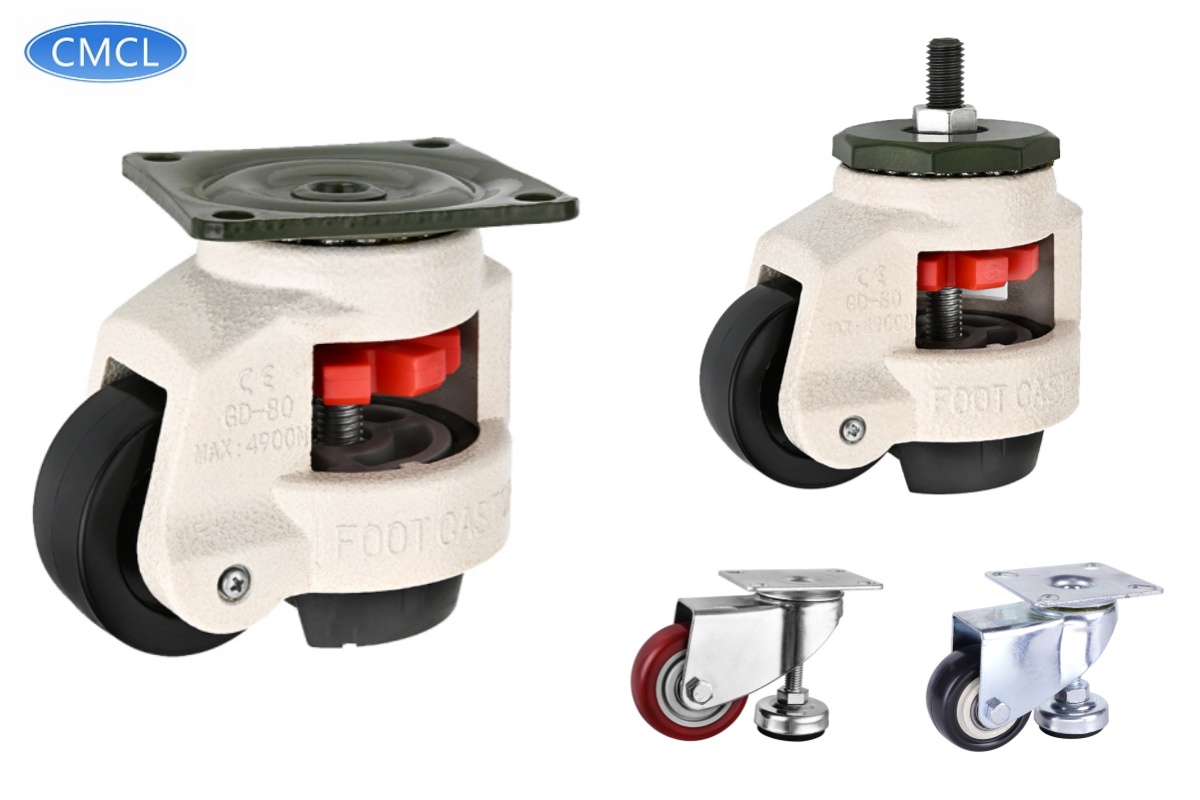
Most adjustable leveling casters hide their real value in the relationship between the stem thread and the mounting plate. A fine-pitch thread lets you dial in small height changes without overshooting, while a sturdy hex or socket at the top of the stem keeps the adjustment from becoming a wrestling match during installation.
The wheel and bracket shouldn't be afterthoughts. Harder polyurethane wheels hold up under static loads without flat-spotting, but a slightly softer durometer can quiet a cart rolling over concrete seams. The top plate or stem needs enough cross-sectional area to resist bending when the load shifts, especially if someone cranks the leveler while it's already under weight.
One often-overlooked detail is how the leveler locks into position. A jam nut against the mounting plate works, but it can loosen from vibration unless there's a polymer insert or serrated contact face. Good designs also limit the exposed thread travel so the stem never fully separates from the bracket, which turns a simple height tweak into a safety issue.
How Stable Foot Pads Protect Floors and Reduce Vibration
Most floor damage from heavy equipment or appliances doesn't happen suddenly—it builds up through constant microscopic pressure points. Stable foot pads change this by spreading the load across a wider surface area, so instead of four small metal or plastic feet digging into vinyl, hardwood, or tile, the weight distributes evenly. The difference is easy to feel: run your hand under a machine with bare feet versus one with pads, and you'll notice the pads allow zero direct contact with the floor. Over months of use, this prevents the characteristic dimples, scratches, and worn spots that force costly replacement or refinishing.
Vibration reduction is often the less obvious benefit, but it matters just as much for both the floor and the machine itself. A washing machine or treadmill in motion creates high-frequency oscillations that travel through rigid feet into the floor structure, causing that low rumble you feel in adjacent rooms. Quality foot pads use dense rubber, cork, or viscoelastic polymers that convert kinetic energy into tiny amounts of heat instead of passing it along. This isn't just about comfort—by cutting down on transmitted vibration, the pads also reduce loosening of internal bolts, protect grout lines, and stop the gradual 'walking' of appliances across smooth floors.
Installation is straightforward, but material choice matters more than most people expect. Hard plastic caps will protect against scratches but do almost nothing for vibration. Felt pads are gentle on floors but compress and lose shape under heavy loads. The best options are medium-durometer rubber or polyurethane blends, which stay resilient years later without becoming sticky or cracking. If your machine sits on a suspended wood floor rather than a concrete slab, you'll notice the improvement immediately—footsteps in the next room won't make the appliance rattle, and you can run the spin cycle without hearing the floorboards hum.
Matching Caster Load Ratings to Real Workshop Conditions
Most caster load ratings assume a clean, smooth floor and a perfectly distributed load. But real workshops are rarely that tidy. A loaded cart parked on an expansion joint, for instance, can transfer triple the static weight to a single wheel when the floor dips. Similarly, rolling over embedded chips or a stray bolt turns a gentle roll into a series of sharp impacts that fatigue swivel bearings far sooner than a smooth warehouse aisle ever would.
Before trusting a catalog number, walk the actual path the cart will travel. Note the worst gaps, the steepest ramp, and whether the load shifts during movement. If you're moving a machine base with a cantilevered motor, the downhill caster may carry 70% of the total weight, not the 25% a four-wheel layout suggests. A good rule is to add 30-50% to the calculated static load per caster, then round up to the next available rating. That extra headroom buys you years of service where a barely adequate caster would fail in months.
Temperature and floor coatings also skew real-world capacity. Polyurethane wheels soften in a paint booth bake cycle, while cold concrete can make nylon brittle. If the workshop floor is sealed or epoxied, wheel hardness matters more than load rating alone. A caster rated for 1,000 pounds may still dig into a soft coating and leave permanent marks. Match the wheel material to the floor chemistry, and treat the load rating as a starting point, not a guarantee.
Installation Steps That Eliminate Machine Wobble for Good
Start by placing a spirit level across the machine's top plate, first front to back, then side to side. Adjust each foot individually until the bubble sits dead center in both directions. A common mistake is tightening the lock nuts before all four feet make firm contact with the floor, which leaves one corner floating and causes a rhythmic thump during operation.
Once the level shows true, run the machine through a short cycle with a moderate load and watch for any movement. If you spot a subtle rock or drift, back off the lock nut on the offending foot, turn the foot a quarter turn at a time, and recheck after each adjustment. This iterative approach beats the usual guesswork because it accounts for slight floor unevenness that a level alone can miss.
For machines that sit on bare concrete or tile, adding dense rubber pads under each foot can absorb the tiny vibrations that remain even after precise leveling. Make sure the pads are rated for the machine's full weight, not just its static load. Finally, retighten every lock nut against the frame by hand, then give each one an extra eighth of a turn with a wrench to prevent creep from vibration.
Choosing the Right Top Plate and Stem for Your Equipment
A top plate and stem might look like simple parts, but mismatched dimensions or thread patterns can cause alignment issues and premature wear. Before ordering, measure the mounting surface and confirm the stem's diameter, length, and thread pitch against the equipment's existing bore or bushing.
Material choice matters more than it seems. For high-vibration or outdoor setups, a stainless steel stem with a zinc-plated top plate resists corrosion and fretting. For lighter indoor rigs, anodized aluminum drops weight without sacrificing stiffness. Check the plate's flatness and the stem's runout if the assembly will hold optical or precision components.
Finally, think about how the stem locks into the plate. A tapered press fit works well for static loads, but a threaded collar or set-screw design allows field adjustments and easier replacement. If your equipment sees frequent teardown, pick a design with a replaceable stem rather than a welded one-piece unit.
FAQ
They are built with thick steel plates, forged kingpins, and hardened ball bearings that can take constant loads from vibrating equipment. The wheel treads are made from cast iron or polyurethane with high durometer ratings, so they resist flattening even when a machine sits in one spot for weeks.
Each caster has a built-in threaded stem or wedge pad that lets you fine-tune the height after the machine is in place. You can raise one corner a few millimeters to eliminate rocking, which is critical for CNC machines, conveyors, and inspection tables that need a true working plane.
Most models are designed with standard top plate dimensions or stem mounts that match common hole patterns, so retrofitting is straightforward. The factory also keeps adapters and metric/imperial stem options in stock, which saves you from drilling new holes in the machine base.
The standard range runs from about 500 lbs per caster up to 10,000 lbs per caster, with a few special-order units reaching higher. They rate them conservatively with a safety factor built in, so a 2,000-lb caster can handle shock loads beyond its static rating.
The caster bodies are typically forged steel or ductile iron, while the leveling pads use hardened steel with a black oxide or zinc finish. For wheels, you can choose polyurethane for floor protection or cast iron for high heat and chemical resistance, depending on your shop environment.
Yes, the better models have a separate brake for the wheel and a locking nut for the leveling stem. That means you can chock the machine in place while still making fine height adjustments, or lock the leveling pad down and let the wheel roll for short repositioning moves.
They have an in-house engineering team that works from your machine drawings or photos. You can request odd stem lengths, non-standard top plate hole spacing, or a different wheel material, and they will send a 3D model for approval before cutting metal.
Conclusion
Heavy machinery often sits unevenly because conventional casters bend or flatten under concentrated loads, causing rocking and floor damage. A top leveling caster factory addresses this by manufacturing adjustable models with reinforced housings and precision-machined stems, so the load path stays vertical even when the floor isn't perfect. These casters combine a swiveling wheel with a built-in leveling pad that extends downward to lift the machine off the wheels once it's in place. That prevents the constant point loading that wears out standard polyurethane wheels and cracks concrete. The adjustable foot pad spreads weight over a wider surface, which reduces vibration transmission and keeps sensitive equipment from drifting during operation. Instead of shimming the machine base with scraps of metal, operators can fine-tune each caster to compensate for uneven slabs, gaps in expansion joints, or worn floor coatings.
But load rating alone is not enough. The factory's engineers match each caster to real workshop conditions, accounting for dynamic shock loads, side thrust, and floor roughness, not just static weight. A machine that rolls smoothly on paper can still hammer a floor if the wheel hardness or top plate size is wrong. Installation follows a simple sequence: raise the machine safely, bolt the correct top plate or threaded stem to the frame, lower it gradually, then adjust the leveling pad until the base is plumb and all wheels are just clear of the floor. Final lock nuts keep the setting from creeping. This approach removes wobble for good and protects both the machine and the floor. Choosing the right mounting style, whether a rectangular top plate for weld-on frames or a threaded stem for tapped holes, makes replacement straightforward and keeps the caster from loosening under vibration. The result is machinery that stays exactly where it is needed, without hammer marks, cracked concrete, or the dull rattle of an unstable load.
Contact Us
Contact Person: Ruby
Email: [email protected]
Tel/WhatsApp: +86 13360379367
Website: https://www.cmcl-casters.com