

Top Distal Access Catheters for Neurovascular Procedures and Improved Outcomes
2026-10-05
When every second counts in a neurovascular case, the tools you choose shape the outcome. Distal access catheters have quietly become the backbone of modern interventions, yet not all are built for the tortuous roads they must travel. This blog dives into the top distal access catheters that are helping teams improve procedural success and patient recovery. One name that keeps surfacing is INT, a brand that has been refining catheter design to meet real-world challenges. If you're looking to navigate complex anatomy with greater confidence, the insights ahead may change how you approach your next case.
The Distal Access Catheter Features That Actually Matter
In neurointerventional practice, the distal access catheter often gets judged by brochure specifications, but the features that actually matter reveal themselves inside tortuous anatomy. A smooth transition in stiffness from the proximal shaft to the distal segment is far more important than a generic claim of a soft tip. Without that graduated flexibility, the catheter can hinge or buckle at the skull base, especially when crossing the carotid siphon or vertebral artery origin. Catheters with an abrupt change in durometer tend to transmit force unevenly, making forward progression unpredictable and increasing the risk of vessel trauma. The best designs manage to feel almost effortless during navigation, not because the tip is extremely floppy, but because the entire distal segment works as a cohesive unit.
Another overlooked characteristic is the true inner lumen behavior under aspiration, rather than the nominal inner diameter printed on the label. A catheter can measure acceptably large on a bench top, yet the lumen can partially collapse or ovalize when negative pressure is applied, especially near the tip where the wall is thinnest for flexibility. This effectively turns a 0.071-inch lumen into something functionally much smaller, choking flow and reducing clot retrieval success. The catheters that perform well in real thrombectomy cases maintain their cross-sectional shape under vacuum while still tracking through challenging curves. Testing this requires more than a caliper; it demands realistic flow models and repeated use in tortuous anatomies.
Proximal pushability and distal trackability need to be balanced with the catheter's behavior in the aortic arch and proximal great vessels. If the shaft is too soft, the pushing force dissipates into loops or prolapse before the tip can advance. If it is too stiff, the catheter may straighten the arch or resist conforming to the vessel, creating undue stress on the intima and making selective catheterization harder. The most practical designs use a braided or coil-reinforced mid-section that transmits force efficiently while allowing the distal portion to flex independently. Additionally, the durability of the hydrophilic coating is not trivial; a coating that wears off during passage through calcified or tortuous segments not only loses lubricity but can also introduce particulate risk. These functional details separate catheters that feel reliable in the hand from those that only look good on a comparison chart.
How Top Catheters Handle Tortuous Neurovascular Anatomy
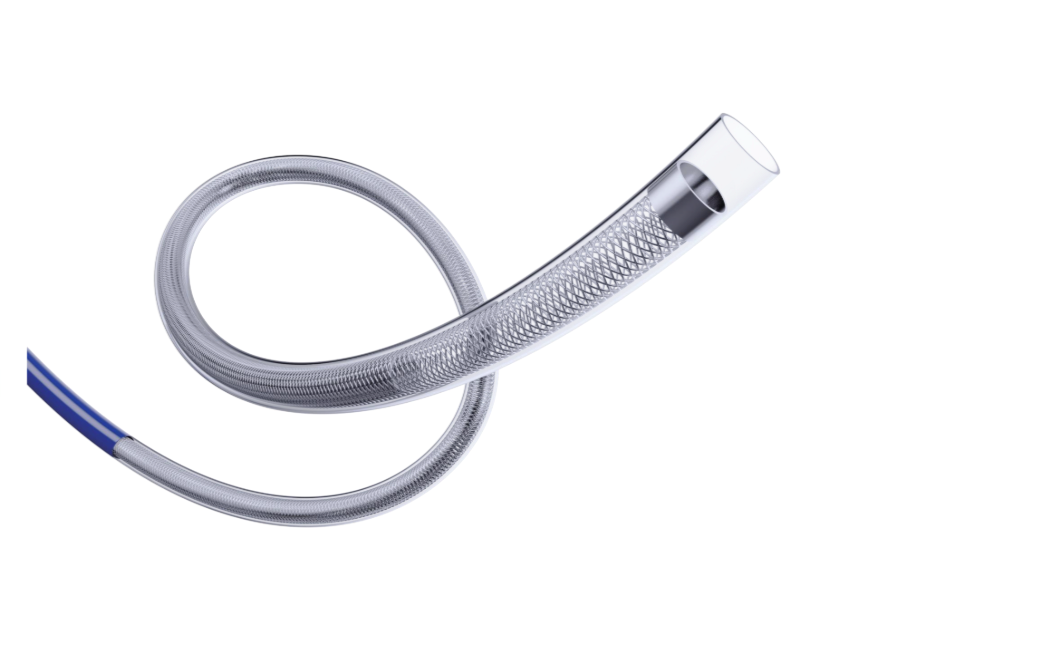
Navigating the carotid siphon or the M1 trifurcation isn't just about pushing a wire; it's a constant negotiation between distal flexibility and proximal push. Top-tier catheters manage this by varying the durometer of their jacket along the shaft in abrupt but tightly controlled zones, so the tip can buckle around a 180-degree turn without sacrificing the column strength needed to advance. Some designs use a laser-cut hypotube in the mid-section that shifts from a spiral to a ladder pattern, deliberately changing the bending axis as the catheter crosses the petrous segment.
Then there's the matter of the inner liner. A braided coil made of flat wire, rather than round, keeps the lumen from kinking when the catheter is forced into a tight loop, while a slippery polytetrafluoroethylene liner prevents the microguidewire from binding under multiple curves. The best catheters don't rely on one coating; they use a differential hydrophilic treatment—denser near the tip, thinner near the hub—so that the device stays wet where friction is highest but doesn't become uncontrollably slick in the operator's hands.
Finally, distal tip geometry plays an outsized role. A straight tip may track well, but a pre-shaped 45-degree or J curve can be steam-shaped to match a patient's particular anatomy, letting the operator rotate into side branches like the ophthalmic or posterior communicating artery without repeatedly withdrawing and reshaping. That kind of adjustability, combined with a short, highly radiopaque marker band, gives real-time feedback about how the tip is interacting with the vessel wall, which is what separates a catheter that merely reaches the lesion from one that works with the anatomy instead of against it.
Reducing Procedure Time with Smarter Distal Support
During complex peripheral or coronary interventions, the lack of stable distal support often forces repeated catheter engagement or guidewire exchanges. Each extra maneuver adds minutes to the procedure and increases radiation exposure. Smarter distal support addresses this by integrating a support design that adapts to vessel tortuosity, keeping the working guidewire anchored without compromising trackability.
Instead of relying on a single stiff segment, newer distal support systems use graduated transitions and shape-memory materials that maintain backup force at the target lesion while remaining flexible enough to navigate branches. This allows the operator to deliver balloons or stents directly to the treatment site without the usual struggle for coaxial alignment. As a result, fewer contrast injections and shorter fluoroscopy runs are needed.
The time saved is not just about speed; it also reduces the chance of device-related complications that stem from prolonged manipulation. When the distal platform stays where you want it, the entire workflow becomes more predictable. Teams can schedule cases more efficiently, and patients spend less time under sedation. That practical difference is what makes smarter distal support a meaningful upgrade rather than a marginal design tweak.
What Improved Outcomes Look Like in Thrombectomy Cases
When a thrombectomy goes well, the change shows up first in the angiography suite: full or near-full reperfusion (mTICI 2b–3) with distal branches filling quickly and no evidence of distal emboli. On the floor, nurses notice earlier return of motor function—hand grip, arm lift, or leg movement that wasn't there before the procedure. By day five, many patients are eating without aspiration risk and starting to transfer with one assist instead of two.
Beyond the immediate exam, improved outcomes show up as a shorter stay in the neuro ICU and fewer rescue interventions for malignant edema or hemorrhagic conversion. Discharge dispositions shift from skilled nursing to acute rehab, and from acute rehab to home with outpatient therapy. At the 90-day mark, the difference is measured not just by mRS 0–2 but by practical milestones: managing medications, walking to the mailbox, returning to part-time work, or resuming a hobby that requires fine motor control.
It is also worth noting what improved does not mean. It does not always mean a perfect recovery, and it does not mean every patient walks out of the hospital. But in successful thrombectomy cases, the trajectory bends—patients who would have been bedbound are sitting in a chair, those who would have lost language are asking for water, and families are planning discharge logistics instead of discussing tracheostomy or long-term care.
Catheter Materials and Coatings: The Hidden Performance Drivers
Catheter performance often gets judged by tip shape or lumen size, but the real differentiator lies in the base materials. Polyurethane blends, for instance, strike a balance between stiffness for pushability and softness to reduce vessel trauma. Silicone, on the other hand, offers exceptional biocompatibility but can feel too floppy in tortuous anatomy. These material choices quietly dictate how a catheter tracks over a guidewire and whether it kinks in a tight bend. Without the right polymer chemistry, even the most advanced tip design falls short.
Coatings are where manufacturers hide some of the most clever engineering. A hydrophilic coating can turn a high-friction surface into a nearly frictionless one when wet, dramatically easing insertion through stenosed lesions. Yet not all hydrophilic coatings behave the same—some swell excessively or slough off under repeated passes. Antimicrobial coatings, often silver-based or chlorhexidine-releasing, address infection risk but can alter the catheter's outer durometer. The best coatings are almost invisible in use: they don't change the feel the clinician expects, but they reduce complications in ways that only become apparent over hundreds of cases.
What truly separates average catheters from exceptional ones is how materials and coatings interact under real physiological stress. A stiff shaft with a too-thin lubricious layer may pass smoothly at first, then seize up as the coating wears away in calcified vessels. Conversely, a soft material with a durable coating can lack the column strength for crossing chronic occlusions. Manufacturers who test these combinations under simulated tortuosity, repeated sterilization cycles, and varying pH conditions end up with devices that feel predictable in the hand. That predictability—not a spec sheet number—is the hidden performance driver that experienced interventionalists notice immediately.
Real User Insights: Where Distal Access Falls Short
In real cases, the biggest frustration isn’t the published reach spec—it’s how the catheter behaves once you’re past the carotid siphon or around a tight vertebral loop. Users describe a “dead zone” where the distal segment folds instead of advancing, forcing them to swap in a stiffer wire or give up entirely and use a triaxial setup. That extra exchange costs time and adds contrast load, which matters more than a millimeter of nominal reach.
Another consistent gap shows up in lumen trade-offs. To get the tip far enough, manufacturers thin the wall and shrink the ID, but then aspiration force falls off and even a 0.021-inch microcatheter feels snug against the inner wall. Interventionalists say they’d rather have a slightly larger profile with predictable tracking than a sleek design that collapses under negative pressure or kinks mid-procedure.
There’s also a durability issue that rarely appears in brochures but gets mentioned frequently in peer-to-peer talks: after a few passes through tortuous anatomy, the distal coating starts to wear, and the tip loses its original shape. That leads to a “sticky” feel against the vessel wall, and some operators have seen intimal irritation during withdrawal. What they actually want is not just more distal access, but repeatable, low-friction control across multiple device exchanges.
FAQ
Distal access catheters are designed to travel further into the intracranial circulation, often reaching segments like the petrous or cavernous internal carotid artery. Their longer, more flexible distal segments and larger inner lumens allow closer positioning to the target lesion, which reduces the gap between the catheter tip and the clot or aneurysm, improving aspiration force and device stability.
By getting closer to the occlusion, a distal access catheter shortens the working distance for stent retrievers or aspiration systems. This proximity increases the vacuum force at the clot interface, reduces the chance of clot fragmentation during retrieval, and allows for more controlled deployment of thrombectomy devices, all of which correlate with higher first-pass recanalization rates.
Look for a balance of trackability, inner diameter, and distal flexibility. A larger inner lumen supports stronger aspiration and compatibility with multiple devices, while a soft, tapered tip minimizes vessel trauma. Braided or coil-reinforced shafts help maintain pushability through tortuous anatomy, and a hydrophilic coating eases navigation. Specific procedural goals, such as radial versus femoral access, also influence the ideal choice.
Neurovascular access often involves sharp bends at the aortic arch, carotid siphon, or vertebral origins. Distal access catheters with graduated stiffness and flexible distal segments can track over a microwire or microcatheter more smoothly, reducing the need for excessive force. This helps maintain access in elongated vessels, prevents catheter prolapse into the aorta, and allows stable positioning even when the parent artery is severely angled.
Enhanced distal support minimizes microcatheter kickback during device delivery and reduces unintended movement of the access system. This stability lowers the risk of vessel dissection, perforation, or embolic showering from disrupted plaque. In aneurysm coiling, a well-seated distal access catheter allows more controlled filling and framing, which may decrease the incidence of coil herniation or thromboembolic events.
Several single-center and registry studies show that contemporary distal access catheters, especially those with .070-inch or larger inner lumens, are associated with shorter groin-to-recanalization times and higher rates of modified Thrombolysis in Cerebral Infarction 2b-3 reperfusion. Some series also report lower symptomatic hemorrhage rates, though randomized comparisons are limited and patient selection remains a key variable.
Newer iterations are being developed with enhanced distal wall compliance to accommodate balloon or stent-assisted coiling without losing proximal support. Some incorporate angled or pre-shaped tips for selective access to difficult branch vessels, while others feature a stepped inner diameter to balance aspiration power with navigability. There is also growing interest in using them for transradial approaches, which requires catheters that perform well despite longer and more tortuous routes.
Conclusion
Distal access catheters have quietly become the unsung workhorses of neurovascular procedures, yet the features that truly matter are frequently buried in spec sheets. Beyond diameter and length, what separates top performers is how they handle tortuous anatomy: a controlled stiffness transition from proximal shaft to distal tip, kink resistance through carotid loops, and enough pushability to track over wire without backing out. The best catheters manage tight curves while keeping the inner lumen round, which directly affects device delivery. One underrated advantage is smarter distal support—when the catheter sits stably in the petrous or cavernous segment, it shortens procedure time by minimizing microcatheter exchanges and giving aspiration systems a firm platform. In thrombectomy cases, that support translates into fewer passes, faster reperfusion, and reduced risk of clot fragmentation.
Materials and coatings are hidden performance drivers that often decide whether a catheter slides through a tortuous vessel or fights every branch. A hydrophilic coating on the distal third lowers friction, but if it extends too far proximally, the catheter becomes difficult to grip and torque. Reinforcement choices—whether braided stainless steel, nitinol, or a hybrid coil—dictate collapse resistance under vacuum aspiration, a critical factor that some real users say still falls short in current models. Operators frequently mention that even premium distal access catheters can lose position at sharply angled bifurcations or flatten during aggressive suction, forcing rescue maneuvers. The practical takeaway is that improved outcomes come less from a single labeled "top" catheter and more from matching these nuanced attributes—stiffness profile, coating placement, lumen stability—to each patient's specific neurovascular road map.
Contact Us
Contact Person: Jeffrey
Email: [email protected]
Tel/WhatsApp: 86-0633-2230056
Website: https://www.sd-intmedical.com