

Shuttle Rotomolding Machine Company Buyer's Guide and Key Considerations
2026-11-16
Most shuttle rotomolding machine buyers begin with a simple question: “How much does it cost?” But the machines that look cheapest on paper often drain budgets through slow cycle times, frequent breakdowns, and hidden tooling limits. Before you compare quotes, it pays to know which features actually matter on the factory floor. This guide breaks down the key considerations—from arm design and oven airflow to after-sales support—so you can evaluate suppliers with confidence. Rising Sun shares field-tested insights to help you avoid common purchasing mistakes.
Shuttle Rotomolding Machines: Strengths and Practical Limits
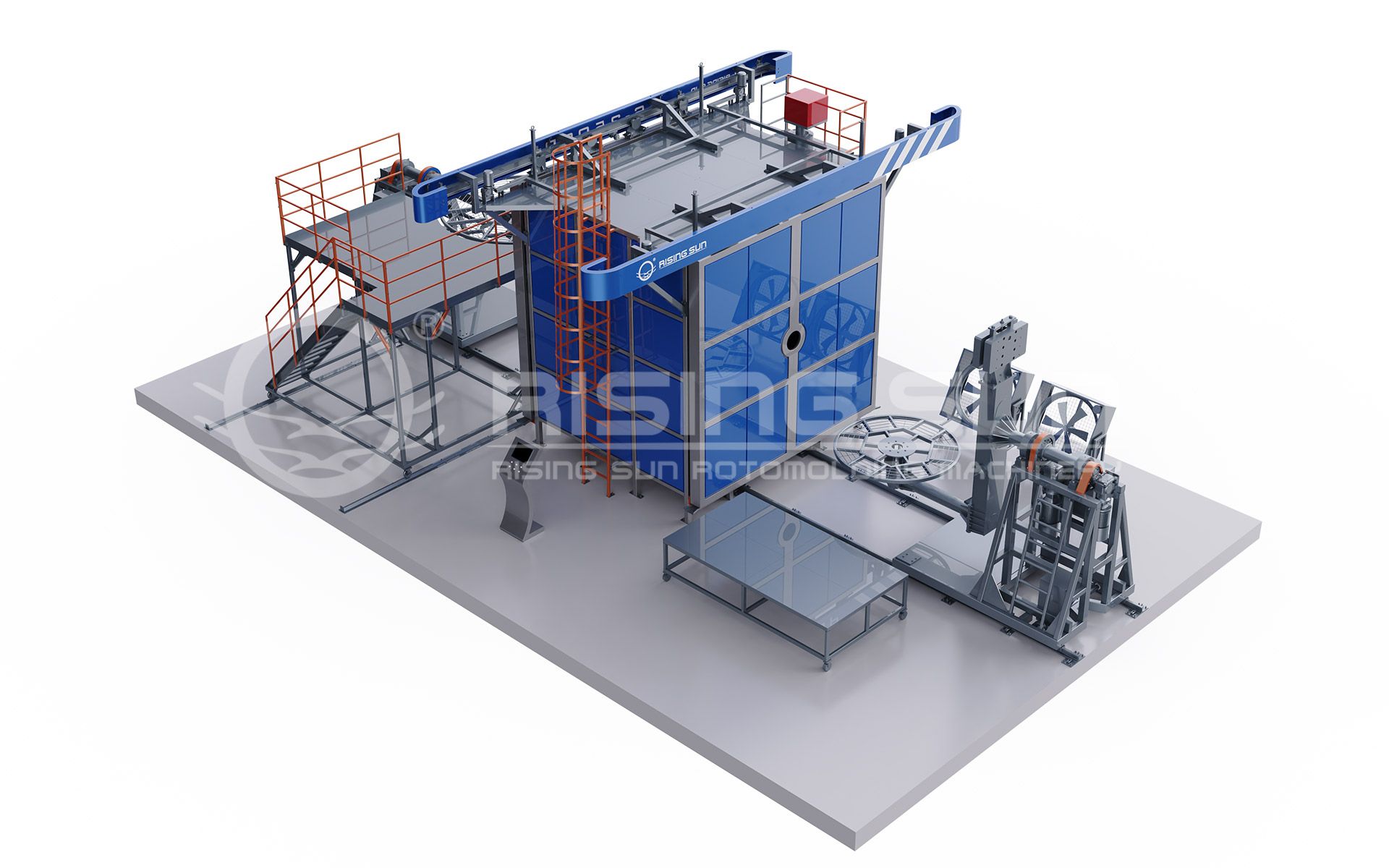
Shuttle rotomolding machines earn their place in shops where flexibility matters more than raw output. The moving arm cycles between heating and cooling stations, letting operators run multiple molds on staggered schedules without waiting for a full carousel to complete. That independent motion cuts down idle time on small-batch runs, and the ability to vary heating intensity or dwell time per arm opens doors for prototyping or short-run production of oddly shaped parts.
On the flip side, the shuttle design forces real compromises. Floor space grows quickly because each arm needs travel lanes, and the open station layout loses heat faster than an enclosed oven, pushing energy costs upward on long cycles. Maintenance also multiplies: separate drive systems, multiple doors, and transfer rails all demand attention, and a fault on one arm often halts the entire line since control logic ties the stations together.
That balancing act between flexibility and overhead is the key decision point. Shuttle machines suit operations where mold changes are frequent, part geometries vary widely, or operators need to fine-tune parameters without disturbing other cycles. When the product mix settles into high-volume, uniform parts, the practical limits of shuttle systems—space, heat loss, and mechanical complexity—usually steer buyers toward a rotary or rock-and-roll setup instead.
Vetting a Manufacturer Beyond the Brochure
Brochures promise consistency, but the real test is how a factory behaves when things go wrong. Request a walkthrough of an active production line, not a staged showroom. Watch for nonconforming parts being segregated, gage calibration stickers that are current, and line workers who can explain the spec without looking at a supervisor. A facility that only looks polished for visitors often hides weak process controls.
Ask for corrective action records from the last six months, not just the ISO certificate. Review supplier audit reports, internal rejects, and customer complaint logs. If they hesitate to share redacted examples, treat that as a signal. A mature manufacturer keeps a living quality history and can discuss root causes without blaming the customer.
Check financial health and workforce stability indirectly. High turnover, late wage rumors, or a sudden shift in raw material suppliers suggest cash flow pressure. Speak to previous clients about what happened after the first order: did tolerances drift, did communication slow down, did hidden fees appear. Those conversations reveal more than a factory tour script.
Mold and Material Compatibility Checks That Prevent Costly Mistakes
Bringing a new plastic part to life often starts with selecting the right resin, but the real hidden risk sits in how that material reacts with the mold itself. Some polymers release aggressive gases during processing that slowly eat away at tool steel, while others demand such high injection pressures that a standard mold base will flex and produce flash after only a few thousand cycles. A compatibility check that maps out chemical resistance, thermal expansion mismatch, and wear characteristics before cutting steel can save months of rework and tens of thousands in tooling repairs.
The testing phase doesn't need to be elaborate to catch most failures. Start with a small coupon mold that replicates the exact gate location, surface finish, and cooling layout of the production tool. Run the aggressive material through it at worst-case melt temperatures and holding pressures, then inspect for micro-cracking, pitting, or dimensional drift after a few hundred shots. Pay special attention to areas where the resin shears hard against the mold wall, like thin ribs or textured surfaces—those are the first places where incompatible materials leave their mark.
What trips up many teams is assuming that because a material worked in one mold, it will transfer cleanly to another with a different steel grade or coating. Tool steels vary wildly in their resistance to acids and abrasive fillers, and a chrome plating that protects against one chemistry can actually accelerate corrosion in another. Before locking in the final tool design, have the material supplier provide documented compatibility data against the exact mold substrate you plan to use, and if that data doesn't exist, budget a short pilot run on a simple test block. The few thousand dollars spent on verification is a rounding error compared to a production tool that starts degrading after its first month on the floor.
Automation Choices That Add Value Without Overspending
Pin down the specific friction points before buying any tool. A lot of teams jump straight to a platform with a per-user fee, only to realize half the automations could have been handled by a simple script or a built-in feature they already pay for. Map out the repetitive tasks, estimate how many hours they actually consume, and compare that against the true cost of a new subscription—including setup time and ongoing maintenance.
Start with small, reversible integrations instead of a full overhaul. Connecting two systems you already rely on can often eliminate the worst manual handoffs without adding another vendor. If a no-code connector or a short piece of custom code does the job, you keep both the budget and the flexibility to change direction later.
Measure the second-order effects, not just the license price. An automation that saves ten minutes a week but breaks every time an API updates is a money sink. Prioritize options that reduce manual checks, simplify onboarding, or cut down on back-and-forth messages. Those quiet wins tend to outlast the flashy dashboards.
Service, Support, and Spare Parts: Terms to Lock Down Before Buying
Most equipment buyers spend hours comparing specs and prices, then sign a contract that leaves service and spare parts vaguely defined. That oversight becomes expensive the first time a critical component fails. Before any purchase, ask for the manufacturer's exact response time commitment—not a vague "prompt support" clause, but a written guarantee such as a four-hour callback or next-business-day on-site visit. Also pin down whether labor and travel are included in the warranty or billed separately, and whether the vendor uses its own technicians or outsources repairs to third parties you have never vetted.
Spare parts availability is where hidden costs multiply. Some suppliers keep regional depots fully stocked; others order parts from overseas only after you report a breakdown, which can mean weeks of downtime. Demand a list of critical spare parts that the vendor commits to holding locally, with a guaranteed maximum lead time for each. Escalating costs are another trap: a part that costs $200 today might be quoted at $600 three years later because the vendor controls the supply chain. Negotiate a fixed-price catalog or a cap on annual price increases for the expected life of the equipment.
Finally, agree on what happens when the equipment becomes obsolete. Many vendors drop support five or seven years after a model is discontinued, leaving you with a machine that still works but cannot be repaired economically. Lock in a minimum support period—ideally ten years for capital equipment—and require written notice of at least 12 months before any end-of-life announcement. If the vendor cannot commit to that, treat the missing commitment as a negotiating point: either a lower purchase price or an escrowed source code and parts drawings so you can have repairs done independently.
The Ten-Year Cost Picture for a Shuttle Rotomolding Machine
A shuttle rotomolding machine spreads its capital cost over a longer horizon than many buyers assume. After the initial purchase, the dominant expense is not the steel or the controls but energy: heating and cooling cycles repeat for every mold index, and older ovens with poor insulation can burn 15 to 20 percent more gas or electricity per cycle. Replacing worn door seals, upgrading burner tuning, and scheduling off-peak runs typically pay back within two years and flatten the ten-year operating curve.
Labor behaves differently. One operator can manage two or three shuttle stations if the loading and unloading zones are ergonomically arranged, so headcount stays flat even as throughput grows. Tooling changes are faster than with carousel systems, which reduces downtime charges that often hide in overhead. Over ten years, the machine's indexed arms and clamps will need bearing replacements and occasional hydraulic hose swaps, but these are predictable line items rather than budget surprises.
The real cost story emerges in product mix. A shuttle design lets you run dissimilar molds on each arm, so low-volume custom parts absorb less setup penalty. If you track cost per kilogram of finished rotationally molded product, the ten-year figure falls when the machine runs at least 60 percent of available cycles. Below that threshold, fixed depreciation and floor space dominate, and a smaller single-station machine may have been the better call.
FAQ
One area that gets overlooked is the actual dynamic sweep of the mold and arms. Brochures often list a maximum mold size without explaining the diagonal clearance needed during rotation. If the mold swings into the oven wall or the floor track during a cycle, you get production delays and damaged tooling. Always ask for the true swept diameter or swing radius at the maximum mold offset, not just the nominal mold envelope.
Even heat distribution depends more on airflow than on the maximum temperature the oven can reach. Look for machines with adjustable air vanes, multiple recirculation paths, or reversing fans that prevent hot spots near the burners. A builder that can show thermal mapping data or actual part temperature curves from a similar shuttle machine gives you a much clearer picture than a simple BTU rating.
Pay attention to how the shuttle frame is welded and stress-relieved, not just how thick the steel looks. Variable frequency drives on both rotation axes and shuttle movement reduce mechanical shock compared to basic contactor or soft-start systems. Ask whether the track rails are machined after welding and whether the chain or gear drives have automatic lubrication. Those details correlate strongly with long-term uptime.
A practical control system should let your staff change per-axis rotation speed, adjust oven and cooling profiles, save recipes for different parts, and view I/O status screens for troubleshooting. If the builder insists that every parameter change requires a service call or a paid software update, that machine will slow down your process improvement work. Look for open access to benign settings with password protection only for safety-critical functions.
Cooling is often treated as an afterthought, but it directly affects cycle time and part warpage. Ask about the blower CFM, whether the station offers adjustable air direction, and if there is an option for water mist or spray cooling. Also confirm that exhaust air from the cooling chamber does not get pulled back into the oven area, otherwise the machine wastes energy and lengthens the heating phase.
Instead of asking for a generic support promise, ask about local spare part inventory, remote diagnostics capability, and the average response time for an emergency breakdown in your region. Ask whether training covers only basic operation or also includes preventive maintenance and recipe development. A builder that charges for every phone consultation after installation will cost you far more over ten years than a slightly higher initial quote.
Yes, because energy cost is a major part of rotomolding economics. Variable frequency drives on the shuttle and rotation motors reduce electricity use under partial load. Better oven insulation, sealed door edges, and modulating gas burners prevent heat loss. Some builders offer heat recovery systems that preheat incoming air or the next mold. When comparing options, ask for energy use estimates based on a reference part with a realistic cycle time, not an ideal case.
Request references from plants that have run the machine for at least three years, and talk to the maintenance technicians, not just the purchasing manager. Ask the builders for the brands of bearings, electrical components, and gearboxes used in their standard builds. Request documentation like weld inspection reports or frame straightness measurements. If a company is reluctant to share those details, treat that as a signal about how they handle long-term support.
Conclusion
Shuttle rotomolding machines earn their keep in plants that need to switch between different part geometries without rebuilding a whole line. Their biggest advantage is flexibility: one machine can run molds for tanks, kayaks, or industrial housings simply by moving carts in and out of heating and cooling chambers. However, this comes with slower cycle times and a larger footprint than carousel or rock-and-roll setups for dedicated high-volume production. Before you commit, watch a candidate machine run your own mold—not a demo part. Evaluate the frame welds, arm alignment, and burner response. Ask the manufacturer for three customers running similar materials and part wall thicknesses. If they hesitate, walk away. Mold and material compatibility is where many deals go wrong: check the swing diameter, platen size, and oven temperature uniformity against your actual resin. A machine that handles polyethylene beautifully may struggle with nylon or crosslinked materials if the heating profile is too aggressive.
Automation should solve a specific bottleneck, not impress visitors. A simple recipe-controlled arm or an extra cooling station often delivers more ROI than a fully robotic unloading cell. Lock down service terms early: response time for controls failures, availability of burner components and thermocouples, and whether remote diagnostics are included. Ask for a list of recommended spare parts to keep in stock and confirm the manufacturer won't discontinue critical boards after five years. Over a decade, the real cost isn't the purchase price—it's energy consumption per cycle, downtime from mold changes, spare part prices, and how well the machine holds calibration. A cheaper machine with poor support and high gas usage can cost twice as much over ten years as a slightly more expensive machine from a responsive supplier. Get those numbers in writing before you sign.
Contact Us
Contact Person: Sharon Zhu
Email: [email protected]
Tel/WhatsApp: 8615712666272
Website: https://www.risingsunroto.com