

PTFE Tube and Rod Manufacturer Insights for Superior Performance
2026-11-16
When it comes to high-performance fluoropolymer components, not all PTFE tube and rod suppliers are created equal. From chemical resistance to tight dimensional tolerances, the smallest manufacturing details often determine whether a part thrives or fails in demanding applications. In this article, we’ll unpack the key production insights that separate reliable extruded and molded PTFE from the rest—and why TAIFNO builds its reputation around those very differences.
Why Raw Material Choice Makes or Breaks PTFE Tube and Rod Quality
The quality of PTFE tubes and rods starts long before any extrusion or molding step — it begins with the raw resin. Not all PTFE powders behave the same way under heat and pressure. A resin with inconsistent particle size distribution can lead to voids, poor surface finish, and uneven density in the final product. Using a lower-grade material that contains recycled content or excessive moisture may pass a quick visual check but will fail under thermal cycling or chemical exposure. For a tube that must hold tight dimensional tolerances, the resin's molecular weight and crystallinity directly influence how much it shrinks after sintering.
Equally important is the type of PTFE selected. Homopolymer PTFE, modified PTFE, and filled compounds each bring distinct processing characteristics. A rod machined from a billet made with a high-flow resin might look flawless on the outside but harbor micro-porosity that weakens its dielectric strength or abrasion resistance. Conversely, using a resin with too low a flow can create internal stresses that cause warping during machining. Choosing the right raw material means matching the resin's rheology to the specific forming method — whether paste extrusion for thin-wall tubing or compression molding for thick rods.
Suppliers who cut corners on raw material consistency often deliver lower lot-to-lot repeatability. This becomes a silent problem on the production floor: a tube that seals perfectly in one batch may crack or leak in the next, not because the design changed, but because the resin changed. The most reliable PTFE products come from manufacturers who treat raw material qualification as a core engineering step, testing each incoming batch for particle size, tensile strength, and thermal stability before it ever reaches the production line.
Extrusion and Molding Trade-offs for Perfect PTFE Dimensional Stability
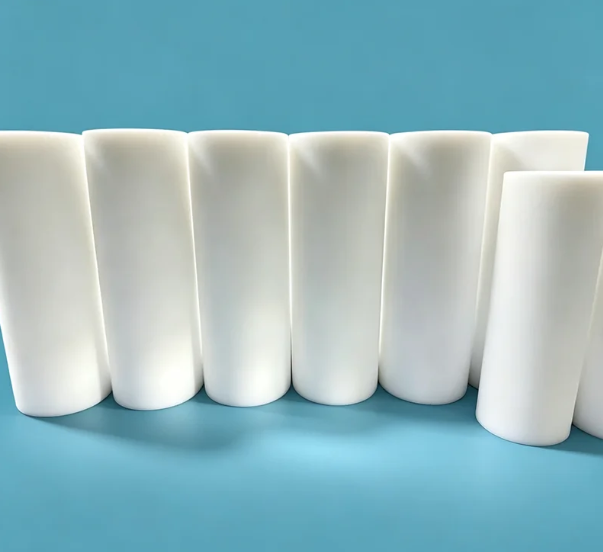
PTFE's dimensional stability is heavily influenced by its processing history. Extrusion and molding are the two primary shaping methods, but they differ fundamentally in how they control internal structure and residual stress. Extrusion subjects the polymer to continuous shear, aligning chains strongly along the flow direction. This yields excellent axial strength, but it also means that shrinkage during cooling and sintering is anisotropic—parts are prone to warping or exceeding tolerance limits. Molding, by contrast, applies pressure more uniformly, resulting in weaker chain orientation in the green compact. Dimensional changes after sintering tend to be more isotropic, yet molded parts can develop density gradients through the thickness, especially in thick-walled sections.
In precision applications, these trade-offs become even more pronounced. Extrusion offers high throughput and is ideal for long rods, tubes, or profiles with large length-to-diameter ratios, but its dimensional tolerance often requires secondary machining because post-extrusion shrinkage depends on die dimensions, puller speed, and temperature profile—any drift in one variable alters the final outer diameter. Molding has longer cycle times and higher tooling costs, but it can constrain free shrinkage within a closed cavity, making it easier to control outer diameter and wall thickness. However, if holding time is too short or cooling is too rapid, internal porosity may remain; these voids can slowly close during service, causing minute dimensional drift over time.
Achieving near-perfect dimensional stability does not mean simply choosing one process over the other. The optimal approach depends on part geometry, tolerance bandwidth, and production volume. For small-diameter rods requiring ±0.05 mm tolerance, a post-extrusion sizing and annealing step can relieve some of the orientation stress. For thick-walled seal rings, a stepped cooling profile during molding reduces residual stress far better than rapid quenching. The boundaries between the two processes are also blurring: some manufacturers now combine molded preforms with extrusion finishing to leverage the strengths of both methods and meet demanding stability specifications.
The Chemical and Thermal Edge of PTFE in Demanding Environments
Polytetrafluoroethylene, better known as PTFE, rarely gets the credit it deserves until a process demands more than standard materials can handle. In aggressive chemical baths or high-temperature chambers, most polymers soften, swell, or shed particles. PTFE does the opposite. Its carbon-fluorine bonds are among the strongest in organic chemistry, giving the material a near-total immunity to acids, bases, and organic solvents. Even aqua regia, which dissolves gold, leaves PTFE untouched. That inertness is not just a laboratory curiosity; it means piping, gaskets, and liners keep their geometry and purity when contact with harsh media would turn other plastics into a maintenance crisis.
Thermally, the story is equally uncompromising. PTFE handles continuous service temperatures from roughly -200°C up to 260°C without becoming brittle or losing its mechanical grip. Unlike materials that rely on plasticizers or fillers for flexibility, PTFE maintains its low friction and non-stick character across that entire range. In cryogenic valve seats, it stays compliant enough to seal. In heat exchanger gaskets, it does not cold-flow into the flow path. This combination of chemical passivity and thermal stability is rare; most so-called engineering plastics trade one for the other. PTFE demands no such compromise.
What makes PTFE truly stand out in demanding environments is not just surviving them, but doing so quietly and predictably. There is no corrosion allowance to factor, no accelerated aging curve from acid vapors, no sudden drop in dielectric strength at elevated temperatures. Engineers specify it because it removes variables. That predictability shortens design cycles and extends service intervals in chemical processing, semiconductor manufacturing, and aerospace fluid systems—fields where a single seal failure can stop a line or ground a vehicle. The edge is not glamorous, but it is real: PTFE lets systems run hotter, dirtier, and longer without asking for attention.
Machining PTFE Rods: Balancing Speed, Tolerances, and Surface Finish
PTFE's low friction and high thermal expansion make it a tricky material to machine at speed. Push the spindle RPM too high and the rod heats unevenly, swelling just enough to throw off a tight tolerance. Most shops learn early that a sharp HSS or carbide tool with a high positive rake angle cuts cleaner than a dull edge, but even then the real constraint is heat management. A modest surface speed of 200–400 feet per minute paired with a light depth of cut keeps the material from smearing or melting at the tool tip, which is the fastest way to ruin both the finish and the dimension.
Holding tolerances on PTFE rods demands a different mindset than metals. Because the material creeps under load and springs back after cutting, you cannot rely on a single pass to hit a plus or minus 0.001 inch spec. Instead, rough out the part leaving 0.010 to 0.015 inch of stock, let it normalize for a few minutes, then take a finishing pass with a fresh edge and a low feed rate. Clamping pressure also matters: a three-jaw chuck tightened too aggressively will distort the roundness, while a collet or soft jaws spread the load more evenly. Checking the part with a micrometer while it is still warm will give a false reading, so let it cool to room temperature before measuring.
Surface finish on machined PTFE is rarely about polishing; it comes down to how the chip forms and releases. A continuous ribbon chip that wraps around the workpiece scratches the surface, so using a chip breaker or an air blast to snap the chip short is essential. Cutting fluid is often skipped because PTFE has natural lubricity, but a light mist of water-soluble coolant helps flush away fines and keeps the tool from loading up. The best finishes come from a very sharp insert with a small nose radius, a feed rate under 0.003 inch per revolution, and a final pass that removes no more than 0.005 inch. When the process is balanced right, the rod comes off the lathe with a matte, even texture that needs no secondary operation.
Beyond the Checklist: Real Quality Control in PTFE Manufacturing
True quality control in PTFE manufacturing starts long before a part reaches the inspection table. A certificate of analysis from the resin supplier is just a starting point. We run our own differential scanning calorimetry on every incoming lot to check molecular weight distribution and thermal history, because even minor lot-to-lot variation in PTFE resin can shift the porosity and creep resistance of finished components. The real work is in interpreting those curves - if a batch shows a slight rise in melt viscosity while still inside the spec window, we adjust the preform pressure and hold time before it becomes a downstream problem.
Sintering is where most hidden failures are born. Automated kiln logs give you temperatures, but they don't tell you if a thermocouple has drifted or if the airflow is uneven near the door. We place sacrificial test bars at multiple points inside the oven during every cycle and section them afterward to check for incomplete sintering or excessive crystallinity. Once we caught a whole run of valve seats that passed surface hardness tests but had a brittle core, simply because a burner port had clogged and created a cold spot. That's the kind of issue a checklist won't catch.
Final testing should be shaped by the application, not by a generic list of mechanical properties. Tensile strength and elongation are fine for baseline data, but if a PTFE seal is going into a hot acid pump, we soak prototypes in the actual process fluid at operating temperature for 500 hours and measure compression set after recovery. Quality engineers need to talk to the customer's maintenance team, understand failure modes, and design tests that mimic those conditions. Otherwise, you're just confirming that the part matches a document, not that it will survive the job.
Partnering with a PTFE Manufacturer: Key Questions to Ask Before You Commit
Selecting a PTFE manufacturer is rarely just about price per kilogram. The right partner should be able to walk you through how their resin grade, crystallinity control, and sintering profile affect your final part's creep resistance, dielectric strength, and surface finish. If they can't explain why one PTFE powder behaves differently from another under your specific molding pressure, keep looking.
Ask about their lot-to-lot consistency data. A supplier who mentions only nominal properties is hiding something. Request actual test results for specific gravity, tensile elongation, and particle size distribution over the last twelve months. Also dig into their change notification process: will you learn about a raw material or process tweak before it reaches your production line, or after you've scrapped a batch?
Finally, don't overlook secondary capabilities. Can they provide skived film, etched surfaces for bonding, or custom blending with fillers like glass, carbon, or bronze? A manufacturer that only extrudes rods may not understand your need for tight thickness tolerance on sheet stock. Press them on lead times for small trial orders and whether they offer technical support when your tooling isn't releasing the part cleanly. These questions separate transactional vendors from engineering partners.
FAQ
It comes down to raw resin selection, dimensional control during extrusion and molding, and how candidly they share process limits. A supplier that tracks lot-level density and shrinkage can predict part behavior far better than one that only checks final dimensions.
The difference often traces back to sintering profile and stress relief. A rod that is cooled unevenly or too quickly retains internal stress, so the moment a tool bites in, the material can distort or chip. Suppliers who control the entire bake cycle produce stock that cuts predictably.
Paste extrusion tends to yield thinner, more flexible tubing with oriented fibrils, which can raise hoop strength in small diameters. Ram extrusion is better suited to larger, thick-walled tubes but requires careful compaction to avoid voids. The right method depends on the pressure, wall thickness, and flex life required.
Besides dimensional checks, look for dielectric strength testing, internal surface inspection, and contamination control during handling. For fluid transfer or medical uses, a manufacturer should also verify extractables and document resin lot traceability rather than relying on generic certificates.
In many cases yes, if the filler is chosen carefully. Glass and carbon reduce creep and improve wear, while bronze handles higher loads. Chemical resistance may shift slightly depending on the filler and the media, so the manufacturer should test the specific formulation rather than assume it matches virgin PTFE.
PTFE has a high coefficient of thermal expansion and can cold flow under load. Without proper sintering and controlled cooling, parts can drift out of tolerance before they even leave the warehouse. A skilled manufacturer compensates in tooling design and verifies stability after thermal cycling.
Ask how they handle mandrel design, wall consistency, and post-sinter sizing. Also ask for small-batch trial runs with process data, not just samples. A supplier willing to share setup sheets and shrinkage rates is usually better equipped for repeatable custom work.
PTFE expands and contracts enough that a warm shop can change a measured diameter by several thousandths. Experienced manufacturers either control the inspection environment or apply temperature compensation, so the part still fits the customer's assembly at its operating temperature.
Conclusion
Raw resin selection sets the ceiling for everything a PTFE tube or rod will ever achieve. Virgin PTFE offers the cleanest chemical profile and highest elongation, while recycled or reprocessed grades introduce inconsistent melt flow and microscopic inclusions that surface later as voids or cracks. A manufacturer that tracks lot-level resin certifications and refuses blended feedstock is already halfway to delivering parts that hold pressure, resist creep, and survive thermal cycling without delamination.
The next differentiator appears in processing. Paste extrusion works well for thin-wall tubing but demands precise reduction ratios to lock in dimensional stability; ram extrusion and compression molding suit larger rods yet require slower cooling to avoid internal stress. After forming, PTFE rods rarely arrive finished. Machining them means cutting at the right speeds with sharp, high-positive-rake tools, balancing chip control against surface tearing, and measuring in temperature-controlled rooms because PTFE moves enough to skew a micrometer. Real quality control goes beyond diameter checks—it includes density tests, dielectric strength, tensile elongation, and DSC thermal analysis to catch short-crystallization batches. Before committing to a supplier, ask how they quarantine non-conforming material, what traceability they keep from resin lot to finished part, and how they handle custom sizes without compromising lead times. These questions reveal whether a manufacturer is truly engineering PTFE for performance or just pushing stock shapes.
Contact Us
Contact Person: Tommy Xiao
Email: [email protected]
Tel/WhatsApp: 8615651509888
Website: https://www.ptfe-factory.com