
ODM Non Woven Geotextile Fabric for Superior Drainage and Long-Lasting Ground Stabilization
2026-09-16
Most ground failures start silently—with water that can't escape. An ODM non woven geotextile fabric changes that by delivering superior drainage and long-lasting ground stabilization from the first layer. Instead of forcing your project to fit a generic roll, JInseed Geosynthetics Solution tailors the fabric to your exact site conditions. What does that mean for your next build? Fewer callbacks, more resilient ground, and a spec that finally works as hard as you do.
How Non-Woven Geotextile Fabric Stops Water Ponding in Driveway Base Layers
Non-woven geotextile fabric keeps the aggregate base from mixing with the soil below. Once that mixing happens, the voids between stones fill with silt and clay, and water has nowhere to go. A properly placed fabric lets water drain down through the stone but blocks the upward movement of fines, so the base stays open and free-draining under repeated wheel loads.
What makes the non-woven type particularly effective here is its felt-like structure. Unlike a woven geotextile that mainly separates, the non-woven material also filters. Water passes through the small, irregular pores while soil particles are held back. That means a driveway base can shed water vertically without creating a perched water table or soft, spongy areas after rain.
For this to work, the fabric needs to be laid over a graded, compacted subgrade with at least 6 to 12 inches of overlap at the seams. It should also be brought up the sides of the excavation slightly. Skipping those edges or using a lightweight fabric under a heavy driveway often leads to localized ponding where water gets trapped between the fabric and the subgrade because drainage paths are blocked.
Reinforce Soft Subgrades for Heavy Traffic Without Relying on Extra Gravel
Adding more gravel to a soft subgrade often masks the real problem instead of fixing it. The wheel loads simply punch through the new layer, pushing the weak soil sideways and creating ruts. A more direct approach is to improve the existing ground itself, turning the top layer of soil into a load-bearing platform without trucking in additional stone.
Geogrids and high-strength geotextiles are effective here because they interlock with the compacted soil and create a tensioned membrane under load. This spreads the pressure over a wider area, so the subgrade doesn't deform as easily. For clay-heavy ground, mixing in lime or cement works well; the chemical reaction dries out the soil and forms a stiff, durable layer that heavy vehicles can pass over repeatedly.
Equally important is keeping water out of the equation. A well-graded crown, shallow side drains, or even a simple impermeable cover can prevent rainfall from soaking the stabilized layer and undoing the work. When the subgrade stays dry and reinforced, it handles heavy traffic with far less maintenance and no need for extra gravel deliveries.
Why This UV-Stable Polypropylene Outlasts Standard Landscape Fabric in Wet Conditions
Most landscape fabrics start to fail when they're constantly wet because the combination of moisture and sunlight breaks down the polymer chains faster than either factor alone. Standard polypropylene often has only a thin UV coating that washes off or degrades after a season, leaving fibers exposed. This fabric uses UV stabilizers compounded throughout the resin, not just sprayed on the surface, so the protection remains even after repeated soaking.
In wet environments, low-grade fabrics can hold water against the soil surface, which encourages mold and mildew growth along the fabric's underside. That biological activity can clog pores and cause the material to sag. The UV-stable polypropylene here resists microbial growth and keeps its weave open, so water drains freely without pooling. The fibers themselves don't swell, rot, or lose tensile strength when saturated.
You'll notice the difference after a heavy rain or in a damp, shaded bed. Standard fabric may tear when you pull back the mulch, but this product keeps its structure because the polymer was designed to handle constant moisture without becoming brittle. That means fewer replacements and less disruption to your planting areas over multiple seasons.
Simple Installation Tips for French Drains, Retaining Walls, and Sloped Ground
French drains fail when the pipe sits flat or the fabric wraps the gravel like a burrito. Give the trench at least a 1% fall, lay perforated pipe holes-down, and keep the stone clean. That way water actually enters the pipe instead of pooling behind it.
For retaining walls, the first block row controls everything. Spend extra time leveling it on a compacted base. Behind the wall, place a drainage column of gravel and a perforated pipe at the footing, not just weep holes. Skip this and hydrostatic pressure will start pushing the wall within a season or two.
On sloped ground, slow water before it picks up speed. A shallow swale above the work area beats a deeper catch basin at the bottom. Terrace small benches into the slope rather than fighting for one uniform grade, and direct the overflow to a planted area instead of bare soil.
Cut Maintenance Costs by Preventing Aggregate Migration Under Paved Surfaces
Loose stone and gravel beneath asphalt or concrete rarely stay put on their own. Over time, traffic loads and moisture cycles push fine particles upward and outward, leaving voids that weaken the pavement structure. Once that base layer shifts, cracks and potholes follow quickly, and repair bills climb with every passing season.
A more practical approach targets the root cause instead of patching the surface repeatedly. Geotextile separation fabrics or graded aggregate blends keep subbase particles locked in place, preventing them from mixing with soft subgrade soils. This simple layer of defense stops the slow loss of material that normally forces early resurfacing or full-depth reconstruction.
The savings show up in more than just fewer emergency repairs. With a stable base, pavements keep their designed load-bearing capacity longer, reducing the need for frequent crack sealing and overlay work. Maintenance crews spend less time on reactive fixes and more on planned improvements, which stretches every dollar of the annual budget further.
Filter Out Fine Soil Particles While Letting Water Pass Through at Full Speed
Water needs to move, but soil shouldn't follow it. This layer doesn't just block fine particles at the surface—it keeps them from migrating while letting every drop pass through at the same rate it would without any filter in place. There's no choking, no pooling, no gradual slowdown as silt accumulates.
The key is in the pore structure, not a single dense membrane. Fine soil particles get trapped in the upper zone where openings are tight enough to hold them, but below that the channels widen dramatically. Water finds those wider paths and moves at full speed, so the fabric never becomes a bottleneck.
That means drainage systems stay responsive during heavy rain, trenches don't turn into mud traps, and the filter keeps working long after typical barriers would have clogged. You get clean outflow and fast passage without having to compromise one for the other.
FAQ
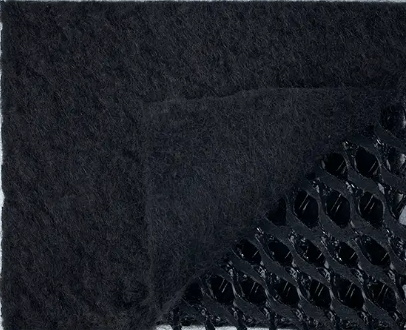
It is a needle-punched, non woven textile made from polypropylene or polyester fibers. Unlike woven fabrics, it has a random fiber structure that gives it high permeability and excellent puncture resistance, making it well-suited for separating soil layers while still letting water pass through.
The open, porous structure allows water to flow laterally and vertically through the material without building up pressure. It acts as a filter that keeps fine soil particles from migrating into drainage aggregates, so water moves away quickly while the soil stays firmly in place.
One common use is under a gravel driveway or parking lot on soft, clay-heavy ground. Placing this fabric down before the gravel prevents the stone from sinking into the mud, so you need less aggregate and the surface stays level for years instead of developing ruts after the first heavy rain.
It is engineered to resist UV degradation during installation and biological attack from soil microbes. The fibers are treated to withstand typical soil pH levels and moisture, so it retains its strength and filtration performance even after being buried for decades.
Yes, it is quite forgiving on rough or sloped ground because it stretches and conforms to the surface without tearing. You just roll it out, overlap the edges by 12 to 18 inches, and secure it with pins or staples before adding your fill material.
Woven fabrics are strong for stabilization but tend to have lower flow rates, which can trap water. Non woven versions prioritize permeability, so they are the better option when you need to control water movement through the fabric while still providing separation and moderate reinforcement.
Check the weight, typically between 4 and 8 ounces per square yard for general use, and confirm the apparent opening size and permittivity from the manufacturer's spec sheet. Also request a sample to test tear strength and fiber bonding, because a cheap, loosely bonded fabric will fail after just one season.
It has good clogging resistance because the needle-punched fibers create a gradient filtration effect, trapping larger particles on the surface while letting finer particles pass in suspension. Over many years some blinding may occur in extremely silty water, but adding a thin sand layer above the fabric greatly extends its effective life.
Conclusion
Water ponding in driveway base layers is a recurring headache, but this non-woven geotextile fabric changes how moisture moves through the ground. Instead of trapping water, the needle-punched polypropylene lets it pass at full speed while holding back fine soil particles that cause clogging. On soft subgrades, the fabric spreads load so effectively that you do not need to keep dumping extra gravel just to keep heavy traffic from rutting the surface. It creates a stable separation layer that stops aggregate from sinking into the mud, which is the real reason many driveways fail early.
In wet conditions, standard landscape fabric often breaks down or loses its filtering ability, but the UV-stable polypropylene used here resists rot and degradation far longer. That matters for French drains, retaining walls, and sloped ground where constant moisture and soil movement eat away at cheaper materials. Installation stays straightforward: roll it out, overlap the seams, and backfill. Over time, the fabric keeps aggregate from migrating under paved surfaces, which means fewer potholes, less regrading, and lower maintenance costs. It is a practical way to get drainage and stabilization without overbuilding the base.
Contact Us
Contact Person: Jerry Qiu
Email: [email protected]
Tel/WhatsApp: +65 84265294
Website: https://www.jinseed-geo.com