

Heavy Weight Soundproofing Blanket Manufacturer Shares Expert Tips for Industrial Noise Reduction
2026-11-17
Industrial noise rarely gets fixed by simply adding more panels or foam. Top Packaging, a heavy weight soundproofing blanket manufacturer, shares the field-tested tactics that actually lower harmful noise levels — and most of them are easier to apply than maintenance teams expect.
Where the Loudest Sources Actually Sit on Your Floor
Most people assume the loudest thing in a room is at ear level, but when you actually get down close to the floor, the ranking changes fast. Hard surfaces reflect and carry low-end noise in ways that make a refrigerator compressor, a subwoofer, or even a forced-air vent sound like it is coming from the middle of the room. Once you put your head near the baseboards, you notice the hum is strongest where the wall meets the floor, not where the appliance sits.
That gap under cabinets and the thin strip beneath interior doors act like small sound channels. A dishwasher pump or a washing machine on spin cycle sends vibrations straight into the subfloor, and the floor itself becomes a speaker. In older homes, loose floorboards and unsealed pipe penetrations can amplify these sounds enough to mask a quieter issue like a failing fan bearing or a slow drip inside a wall.
The useful trick is to place your palm flat on the floor and move it in a slow grid. The vibration tends to peak just before the visible source becomes obvious, which tells you the actual path the noise is taking rather than the spot your ears first pointed to.
Reading the Noise Signature Before Selecting a Blanket
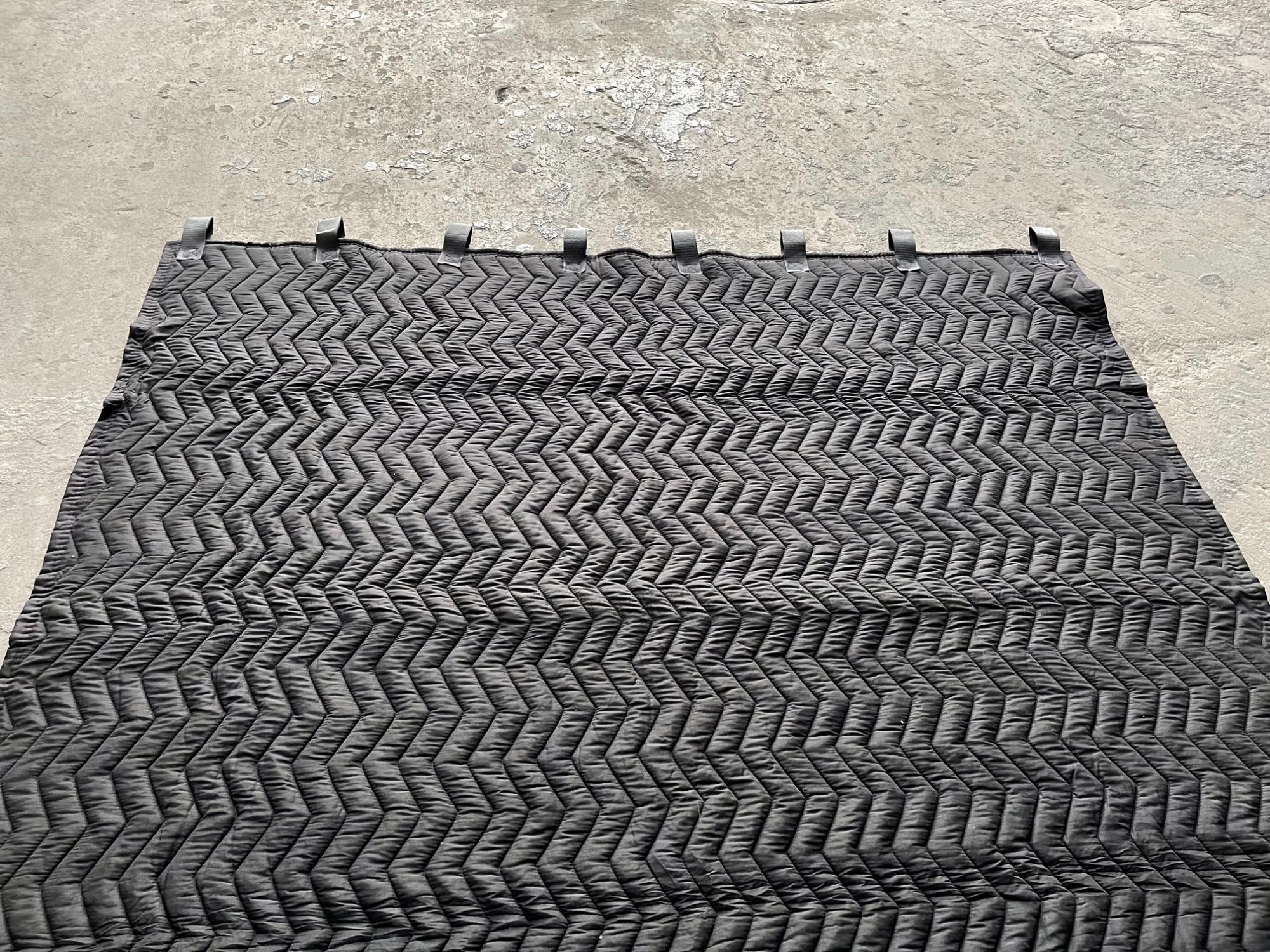
Most facilities wait until noise has already become a complaint before looking at acoustic blankets, but the selection process should start with the actual sound profile. A blanket that works well for a high-pitched fan whine can be nearly useless against the low rumble from a compressor or chiller. Walking the space with a basic sound level meter and noting the dominant frequencies, not just the overall decibel reading, gives a clearer picture of what the blanket must interrupt.
It also helps to separate continuous noise from intermittent peaks. A pump that cycles on and off, or a valve that releases pressure in short bursts, creates a different signature than a steady motor hum. Those peaks often determine how the blanket should be fitted and whether edge seals or layered mass are needed, since leaks around the perimeter tend to let sharp bursts through even when the main panel performs well.
Reading the noise signature before choosing a blanket prevents the common mistake of buying by thickness or price alone. If the measurement shows energy concentrated in lower bands, dense, limp-mass materials are usually more effective; if the problem sits in the upper range, a lighter composite with sound-absorbing facing may be enough. Matching the material to the measured signature makes installation simpler and avoids overbuilding the solution.
Getting the Fit Right Around Pipes, Panels, and Odd Shapes
A cardboard template beats a tape measure almost every time you have to notch around a pipe or an outlet box. Cut the shape roughly, press it into place, and trim the high spots until the template sits flat. Once you have that, transfer the outline onto the workpiece and remember to flip the template when you mirror the cut.
For panels that meet baseboards, door casings, or uneven plaster, leave a little more room than looks right at first. Forcing a tight butt joint tends to buckle the panel or expose a gap the moment the material expands. Cut shy of the line, dry-fit the piece, and shave the edge with a sharp blade until it drops in with light finger pressure.
Odd shapes are rarely as complicated as they appear once you stop trying to measure every bump. Run a contour gauge or a simple washer-on-a-string trick along the profile, trace that line onto the back of the material, and make a series of shallow relief cuts. Removing small amounts keeps the edge clean and lets you sneak up on a fit that looks scribed rather than hacked.
Why Small Gaps Sabotage an Otherwise Solid Barrier
A barrier rarely fails because the material itself is weak. It fails because air, water, or sound finds a seam that was treated as an afterthought. Even a gap no wider than a fingernail gives pressure a place to push through, and once that route exists, the surrounding strength becomes almost irrelevant.
Small openings also create their own quiet momentum. Moisture works into a hairline crack through capillary action, temperature differences pull warm air outward, and wind turns a tiny puncture into a fluttering edge that slowly widens. The gap does not need to look serious to behave seriously over time.
The practical fix is usually less about adding more weight to the barrier and more about interrupting the path at the exact point of weakness. Sealing a joint, closing a corner, or filling an overlooked penetration often changes the performance more than upgrading the main surface. That is why the smallest detail can decide whether the whole assembly holds or quietly leaks.
The Fastening and Sealing Details Most Teams Skip
Most crews will hit the obvious bolt torque, but they overlook thread condition and lubrication. A dry or damaged thread can produce a false torque reading, so the wrench says it is tight while actual clamp load is still low. The sequence matters too: jumping around the flange or pulling one side down fully before the other leaves uneven compression that can open up later.
On the sealing side, clean mating surfaces are often assumed rather than checked. Old gasket material, shallow scratches, or a small piece of debris will create a leak path even with a new gasket. Flange alignment is another quiet failure point. If the faces are not parallel before fasteners are drawn in, the gasket gets pinched on one edge and underloaded on the other.
Finally, most teams skip the follow-up pass. Fasteners relax after heat cycles, vibration, and gasket compression set. A short recheck window, marked fasteners, and a fixed torque pattern catch loosening before it becomes a leak or a loosened joint.
How to Tell When a Blanket Is Losing Its Effectiveness
A blanket usually gives you small, physical clues before it stops working altogether. Run your hand across the surface and pay attention to whether the fill feels uneven, clumped, or noticeably flatter under the shoulders and hips. If you hold it up to a light, thin patches may show through where the weave has loosened or the batting has shifted. The edges can also start to feel limp instead of crisp, and stitching may pull away without much effort.
The easiest test is how you sleep. If you keep reaching for an extra layer or waking up with cold feet even though the thermostat hasn't changed, the blanket is no longer holding in the warmth it once did. After washing, notice whether it takes longer to dry or stays damp in the center; that often means the fibers have compacted and lost their loft. A good blanket should recover its shape after being folded or washed, not stay pressed flat.
FAQ
The difference comes down to mass and construction. A real heavyweight unit uses a limp-mass barrier layer sandwiched between absorptive faces, often with a reinforced vinyl or weatherproof outer shell. That mass is what blocks low-frequency mechanical noise, while the outer layers soak up mid and high frequencies. Standard absorber blankets mostly reduce echo and can leave the underlying rumble almost untouched.
Thickness is less important than weight per square foot and the mix of layers. For pumps and compressors, look for a blanket rated at one pound per square foot or heavier if the dominant annoyance is a low hum. If the noise has a sharp hiss or whine, make sure the inner face is a porous absorber. Often a one- or two-inch blanket with a dense barrier core outperforms a thick fiberglass-only wrap.
They can, but only if the outer fabric and core are selected for the temperature. Ask for a flame-rated or high-temperature facing and keep any standard PVC shell away from direct welding sparks or surfaces above its rated limit. A common expert practice is to use a heat-reflective outer layer on the machine side and leave an air gap between the blanket and the hot surface.
Leaving gaps and unsealed seams. Noise behaves like water; a small unsealed edge or missing overlap can let a surprising amount of sound escape. Effective installations overlap adjoining blankets by several inches, seal vertical joints, and run panels from floor to ceiling or fully around the noise source. Even high-mass blankets perform poorly when treated as partial curtains.
It depends on the space, the source, and how complete the barrier or enclosure is. A well-sealed partial enclosure might deliver a 5 to 10 dBA drop at nearby workstations, while a fully sealed enclosure can push reductions higher. Since a 10 dBA drop is usually perceived as roughly half the loudness, the practical goal is often to bring levels under a workplace limit rather than chase a specific number.
Yes, provided they are built for weather exposure. Choose versions with UV-stable outer shells, sealed or welded seams, and drainage grommets so water does not pool. Outdoor installations need a rigid frame or cable support to handle wind load. For rooftop units, also check weight limits and make sure the mounting system does not create a new maintenance obstruction.
In heavy-use or outdoor areas, inspect them quarterly. Look for torn grommets, failed stitching, cracked outer shells, and any barrier layer that has become compressed or saturated. A blanket with a split shell can still look usable but lose most of its low-frequency blocking. Replace damaged panels rather than taping them, because tape and patch jobs rarely restore the original acoustic seal.
Add a second layer with an air gap between the two blankets. The gap acts as an extra buffer and improves low-frequency performance more than simply doubling the thickness. It also helps to isolate the equipment from the support structure with vibration pads, because structural noise can bypass the blankets entirely and radiate through floors and walls.
Conclusion
A lot of plant floors get treated as one uniform noise problem, but heavy-weight soundproofing blanket manufacturers tend to start much closer to the actual source. The loudest spots are rarely spread evenly across a space; pumps, compressors, punch presses, and high-velocity duct runs each leave their own footprint. Reading the noise signature before choosing a blanket matters just as much as the decibel reading. High-frequency hiss behaves differently from low-end rumble, and a dense composite facing that handles one may do little for the other. Once the source and frequency profile are clear, the next step is fit. Pipes, flanges, access panels, and irregular housings need cuts that wrap tight without relying on tape or cramming material into shapes it was never meant to hold.
Even a heavy barrier loses much of its value when small gaps are left open around brackets, conduits, or seams. Sound finds those paths quickly, so fastening and sealing details become the real difference between a tidy install and one that actually lowers exposure. Overlapping edges, hook-and-loop closures, and high-temperature ties need to be checked after the first thermal cycles and again as part of routine rounds. Performance also drifts with time. If a blanket is stiff, torn, waterlogged, or no longer springs back along its edges, it is probably passing more sound than the spec suggests. Rather than replacing on a fixed calendar, teams get better results by watching for those physical signs and addressing problem zones before nearby workers start compensating with hearing protection.
Contact Us
Contact Person: Shelly
Email: [email protected]
Tel/WhatsApp: 86-577-64286522
Website: https://www.topmovingpad.com/