

China Plank Grating: Essential Insights for Smart Procurement
2026-11-16
Procuring plank grating from China doesn’t have to feel like a gamble. Between fluctuating steel prices, inconsistent quality, and opaque supplier networks, the margin for error is real—but so is the opportunity. In this guide, we unpack the essential insights that separate a smart purchase from a costly mistake, with Sino Grating leading the conversation on dependable sourcing.
What Qualifies as Plank Grating in Chinese Manufacturing?
Plank grating in Chinese manufacturing is defined less by a universal standard and more by the specific load-bearing and dimensional requirements of the project at hand. Typically, it refers to a welded or press-locked assembly where flat bearing bars—often called planks—are spaced wider apart than in standard industrial grating, usually exceeding 50 mm center-to-center. The cross bars, which hold the planks in place, may be flattened or twisted, but the key distinguishing feature is the plank's cross-section: often taller than it is wide, giving the grating a directional strength suited for forklift traffic, mezzanine decking, or trench covers that must withstand heavy, rolling loads without excessive deflection.
What truly qualifies a product as plank grating in this context is its manufacturing tolerance and material consistency. Chinese mills commonly produce plank grating from carbon steel, galvanized steel, or stainless steel, with bar thicknesses ranging from 3 mm to 8 mm and depths from 25 mm up to 75 mm or more. The plank's surface may be plain or serrated for slip resistance, but the critical qualification is the absence of visible weld splatter, uniform spacing between bearing bars, and a flatness that does not deviate more than 3 mm per meter. Many domestic projects also demand a specific yield strength—often Q235 or Q355 grade steel—to ensure the grating can handle dynamic loads without permanent deformation.
In practice, Chinese fabricators differentiate plank grating from conventional bar grating by its intended use in high-cycle or heavy-duty environments. For example, coal processing plants, shipyards, and loading docks frequently specify plank grating with a bearing bar pitch of 60 mm or 80 mm, paired with cross bars at 100 mm or 50 mm intervals, to balance weight savings and rigidity. Qualification also involves a load test report, often carried out per GB/T 13912 or a client-specific standard, confirming that a single plank can support a concentrated load of at least 1.5 tons without cracking at the weld joints. Without such documentation, the product is typically classified as ordinary grating, regardless of its visual similarity.
Material and Coating Options for Corrosive and High-Wear Settings
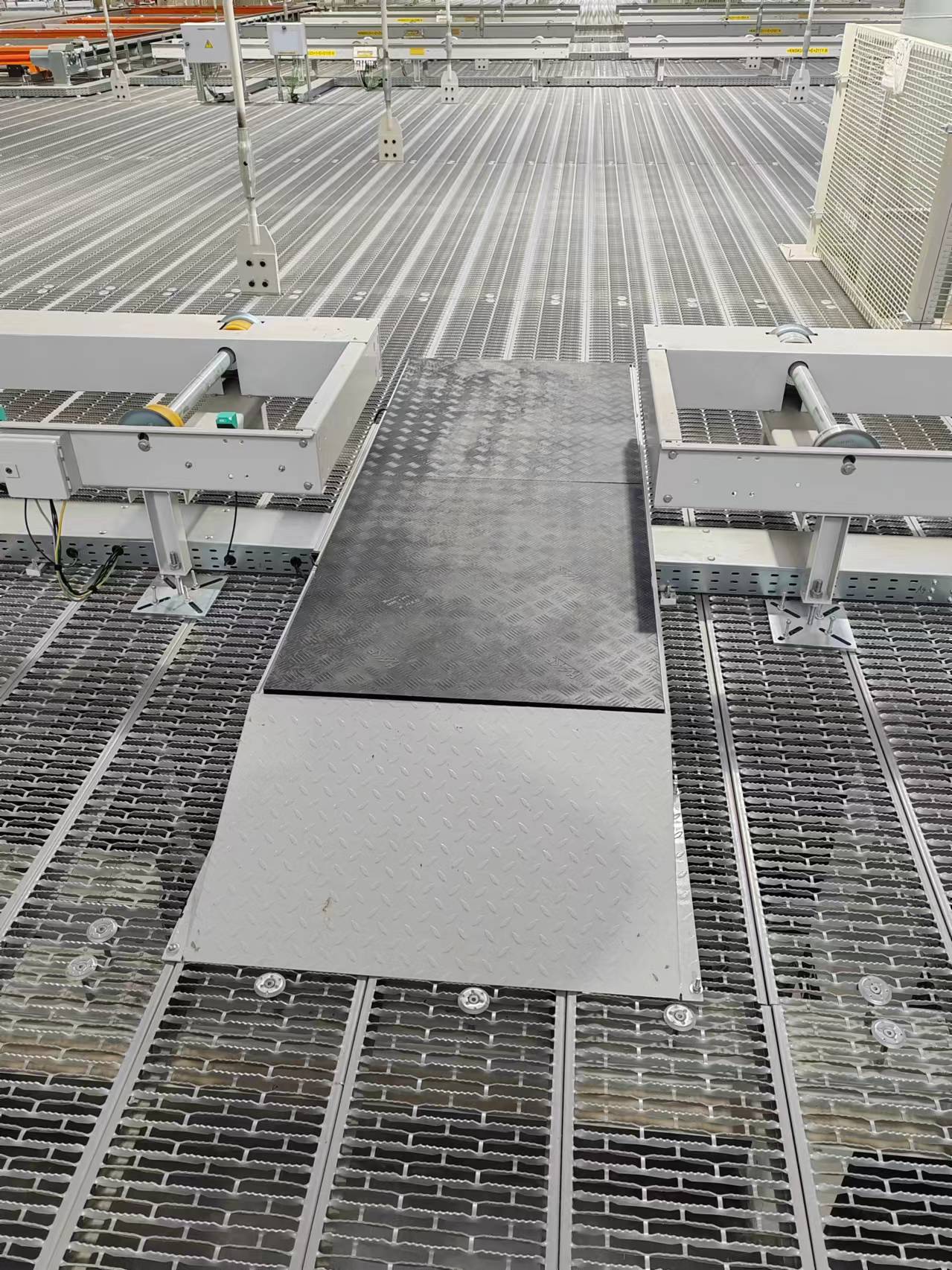
In environments where aggressive chemicals meet continuous abrasion, material selection often starts with high-alloy stainless steels and nickel-based superalloys. Grades like 2205 duplex and super duplex stainless steels offer a balanced blend of pitting resistance and mechanical strength, while Hastelloy and Inconel variants handle extreme pH swings and chloride attack without sacrificing toughness. For sliding or impact wear, through-hardened tool steels and cobalt-chromium alloys remain reliable, though their corrosion resistance depends heavily on precise heat treatment and surface finish.
Coatings extend service life when monolithic metals fall short. Thermal spray methods such as HVOF (high-velocity oxygen fuel) deposit dense tungsten carbide or chromium carbide layers that withstand both erosion and acidic exposure. Thin-film options like PVD-applied titanium nitride or diamond-like carbon reduce friction and resist galling, though they require a well-prepared substrate to avoid premature spalling. In less demanding chemical settings, fusion-bonded epoxy and fluoropolymer linings offer cost-effective barriers, but they need regular inspection at seams and edges where wear concentrates.
A practical approach pairs the right base metal with a compatible coating rather than chasing a single miracle material. For example, a 316 stainless steel housing with a HVOF-applied WC-Co-Cr coating handles dilute sulfuric acid with suspended abrasive particles far better than either component alone. Field data from pump and valve rebuilds shows that such combinations can double or triple mean time between failures, provided the coating thickness is matched to the expected wear depth and the base material retains enough corrosion allowance for any coating breach. Regular monitoring of surface roughness and microhardness helps catch early coating degradation before it exposes the substrate.
Dimensional, Load, and Deflection Figures to Confirm Before Ordering
Before you commit to an order, pull the drawings one more time and look past the overall dimensions. Pay attention to how the part is actually constrained in the assembly. A beam that looks fine on paper can twist or walk if the end connections leave too much room for interpretation. Check the true centerline-to-centerline spacing, the bolt hole edge distances, and whether the section depth matches what the fabricator can realistically roll or weld. If the member is long, ask for the camber at mid-span instead of assuming it will come out straight. These are the numbers that get missed on a quick takeoff and cause field cuts later.
Load figures should be tied to the deflection limit you are actually trying to hold, not just the maximum stress. A floor beam can pass a bending check and still feel bouncy under foot traffic. Ask for the live load deflection under unfactored loads, and compare it to the span over 360 or over 480 depending on the finish above. If the beam supports a brittle partition or a glass wall, tighten the limit further. Also confirm whether the load is uniformly distributed or comes in as a point load from a column above. The wrong load case will change the flange thickness and the bearing stiffener requirements.
Finally, request the deflection values for both the dead load and the superimposed load separately. Fabricators often combine them and report a total that hides how much sag is already locked in before the building is occupied. If the dead load deflection exceeds an eighth of an inch on a long span, it may show up as a visible dip in the ceiling line. Checking these three groups of figures before the order is released costs a few minutes on the front end and saves weeks of remedial work after erection.
Direct Manufacturers vs. Trading Companies: How to Spot the Difference
One of the quickest ways to separate a direct manufacturer from a trading company is to probe the technical depth of their answers. A factory contact usually knows not just the product specs but the reasoning behind material choices, tolerances, and common failure points. Ask what happens if a certain component is substituted or how they handle a specific surface finish under high humidity. A trading company will often need to relay the question to someone else, producing vague or delayed replies, while a manufacturer can walk you through the production step in detail, sometimes with photos or live video from the floor.
Another telling sign is how flexible they are on small changes. Direct manufacturers can often adjust dimensions, packaging, or even raw materials at the line level because they control the process. Trading companies, by contrast, tend to push back on anything outside the catalog, since they have to renegotiate with the actual factory and may lose margin. If you ask for a minor tweak—say, a slightly thicker gasket or a different inner carton—and the response is immediate with a revised quote, you're likely talking to the source. If the answer is "we will check with our factory," that is not proof of being a middleman, but combined with other clues, it leans that way.
Look at the product range and the contract terms as well. A true factory often focuses on a narrow family of items that share tooling or assembly lines, while a trading company can list hundreds of unrelated products to look capable. Also, direct manufacturers tend to request more specific details upfront—exact quantity, dimensional drawings, target price—because they need to schedule tooling and raw materials. A trading company may accept loose specifications and promise fast sampling, because their real value is sourcing rather than making.
Packing, Inspection, and Delivery Details That Shape Your Timeline
You can trace nearly every delivery delay back to a choice made long before the truck shows up. Packing that looks sturdy on the dock often hides the kind of variability that slows things down later: mixed carton sizes force manual sorting, thin edge protectors invite damage claims, and a missing pallet label turns a 10-minute unload into a 40-minute search. None of these are dramatic, but together they redefine what on time actually means.
Inspection has a similar way of quietly consuming hours. When every order gets the same full inspection, even repeat items wait for checks they don't need. A smarter approach ties the depth of inspection to the product's history and the buyer's tolerance for risk, which can cut a two-day hold to a same-day release. Delivery then becomes less about distance and more about fit: a truck that arrives outside the receiving window, or without the right liftgate, doesn't just sit, it backs up the whole week. Tighten those details and the timeline stops being a guess.
Cost Factors Beyond the Basic Per-Ton Quote
A quote that lists $480 per ton doesn't mean you'll pay $480 for every ton you receive. Freight alone can swing the delivered cost by 15% or more depending on whether the material ships from a nearby depot or a mill three states away. Fuel surcharges, accessorial charges for residential or construction-site delivery, and even tolls get passed through, often buried in the fine print.
Material specs and order size are another quiet cost driver. If you need tighter thickness tolerances, a specific alloy blend, or cut-to-length pieces rather than standard coils, expect per-ton adjustments that don't show up in the headline number. Small lot orders may trigger minimum processing fees or warehouse handling charges, which can make the effective cost per ton jump well above the quoted base.
Then there's the time and paperwork side. Payment terms matter: a 2% discount for paying within ten days changes the real price, while extended credit often costs more. If delivery timing slips and the material sits at a port or rail yard, demurrage and storage fees accrue daily. Don't overlook certificates of compliance, test reports, or special packaging—each adds a few dollars per ton that never made it into the initial quote.
FAQ
Look beyond the quoted price. Confirm the raw material source—whether it's Q235 carbon steel, 304 or 316 stainless, or fiberglass—and ask for mill certificates. Also verify the bearing bar thickness and spacing because these directly affect load capacity and long-term performance.
Most offer hot-dip galvanizing, but the zinc coating thickness can vary. Request at least 70 microns for outdoor or corrosive environments. Some workshops also provide powder coating or epoxy paint for aesthetic or chemical resistance needs, so it's worth specifying the exact exposure conditions.
Yes, but it depends on the factory. Many medium-sized manufacturers accept flexible orders if you're willing to pay a small tooling or setup fee. Standard panel sizes and common bearing bar profiles are easier to source with low MOQs, while highly customized cutouts or non-standard materials may need a larger commitment.
Ask for a detailed packing list, material test certificates, galvanizing thickness reports, and third-party inspection reports if possible. Also request photos or videos of the finished grating and the loading process—this reduces surprises after it leaves the port.
Don't rely only on a website or chat responses. Request a live video tour of the production line, ask for recent export records or references in your region, and check whether they have experience with the specific standards your project needs, such as BS 4592 or AS 1657.
Underestimating freight costs for heavy steel products and ignoring import duties or local certification requirements. Also, ordering without clarifying tolerance standards can lead to installation headaches. A good practice is to confirm dimensional tolerances and flatness allowance in writing.
Location matters less than the production equipment and quality control system. Coastal factories may have easier logistics, but inland ones sometimes offer better pricing and less rush. Focus on whether they have automated welding lines, proper shearing and punching machines, and a dedicated QC team.
Typically 3 to 5 weeks after deposit and drawing approval. Peak construction seasons or major holidays like Chinese New Year can extend this to 6 to 8 weeks. Always build buffer time into the project schedule and confirm the production timeline before signing.
Conclusion
China's plank grating sector generally defines the product as a welded grid of flat bearing bars and twisted or round cross rods, often produced in standard panel sizes such as 1,000 mm by 6,000 mm but widely customizable. The practical reality for procurement is that you must specify the bearing bar depth and thickness, the spacing between bars, and the type of cross rod, because these directly control load capacity and deflection. Material choice is not a one-size-fits-all decision: plain carbon steel with hot-dip galvanizing works for most outdoor industrial plants, while 304 or 316 stainless steel becomes necessary in coastal, chemical, or food-processing environments. Some buyers overlook alternatives like aluminum or press-locked construction, which can reduce weight or improve corrosion resistance in niche applications. Before placing an order, ask for exact deflection figures at the design load, not just a generic heavy duty label. A 30 mm bearing bar on 30 mm centers will behave very differently from a 25 mm bar on 40 mm centers, and the difference shows up as bounce or permanent sag in service. Chinese factories typically follow YB/T 4001 or can align with ASTM A380/ANSI standards, but you must confirm which one applies to your batch.
Separating genuine manufacturers from trading companies is easier when you request live factory videos, recent export records, and the ability to control raw material sourcing. A real producer can show the welding line, the galvanizing bath, and the cutting tolerance range; a trader often cannot. Packing and delivery details matter more than many first-time buyers expect. Proper export packing uses wooden pallets or steel frames with edge protectors, and each bundle should carry clear markings for size, quantity, and heat number. Inspection should not stop at visual checks: ask for mill certificates, load test reports, and third-party inspection before shipment. Delivery timelines shift with port congestion, so agree on a realistic lead time that includes internal transport and customs clearance. On cost, the basic per-ton quote is only a starting point. Surface treatment thickness, tolerance class, cutting waste, special edge banding, palletizing, inland freight, and payment fees can add 10-20% or more. Smart procurement means building a landed cost model that includes all these variables, and then comparing quotes on equal technical specifications rather than on a headline number. The real savings come from avoiding rework, delays, and mismatched load ratings.
Contact Us
Contact Person: Nicholas Zhu
Email: [email protected]
Tel/WhatsApp: 18921275456
Website: https://www.sino-grate.com